
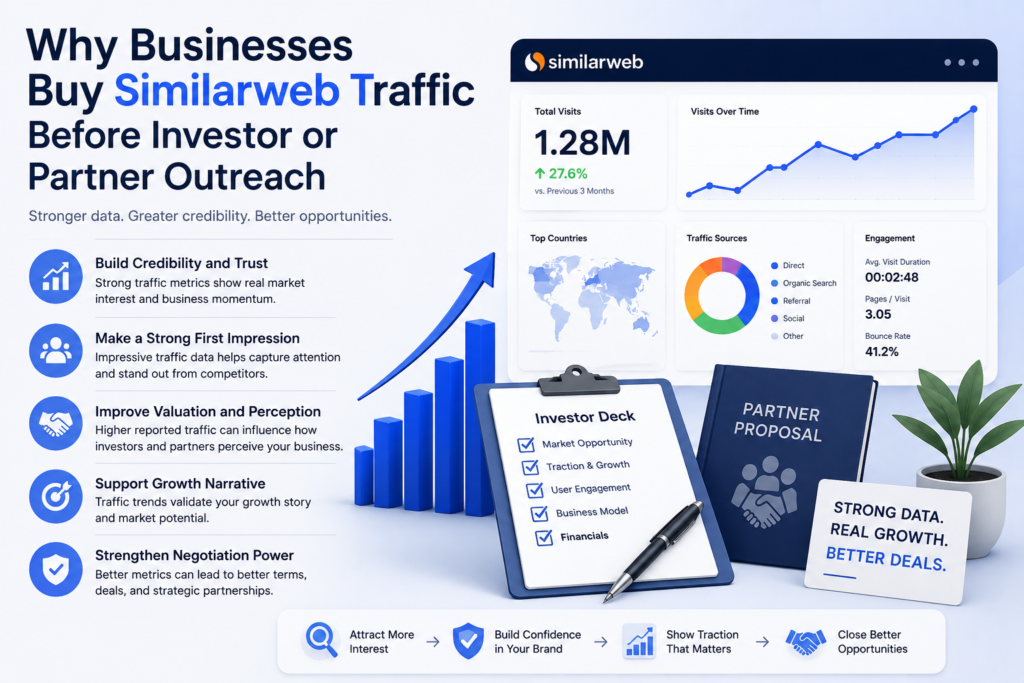
Why Businesses Buy Similarweb Traffic Before Investor or Partner Outreach
Before a first call with an investor, a partnership manager, or an affiliate network, the other side has almost always already looked you up. The first stop is rarely your website itself. It is a third-party intelligence tool, and most often that tool is Similarweb. Within thirty seconds, someone you have never spoken to has formed an opinion about your traction, your market position, and whether you are worth a serious conversation. That opinion is built on data you did not produce and cannot easily correct.
This is the practical reason a growing number of companies pay attention to their similarweb website traffic before high-stakes outreach begins. The goal is not deception. It is to ensure that the external picture of the business matches the internal reality, particularly for companies where private analytics tell a stronger story than the public estimates suggest. When the gap between what you know about your traffic and what Similarweb reports is wide enough to undermine a conversation before it starts, fixing the external picture becomes a legitimate business priority.
How decision makers actually use Similarweb data
Investors, partners, advertisers, and affiliate networks all use third-party traffic data in roughly the same way: as a fast filter. Before scheduling a call, before responding to an inbound message, before sending a term sheet, they want a defensible read on whether the business is real. Similarweb provides that read in a single dashboard, with monthly visits, engagement metrics, geographic distribution, and source breakdowns visible at a glance.
The filter is binary more often than people realize. A site with no measured traffic at all, or with traffic that looks disproportionately small relative to the company’s claims, frequently gets deprioritized without a follow-up. The reasoning is not malicious. Decision makers process dozens of opportunities a week, and external traffic data is one of the cheapest signals available for ranking them. If your profile suggests a smaller operation than your pitch describes, the assumption defaults to the data, not the pitch.
This is the core problem that paid traffic supplementation addresses. The business may be real, the revenue may be growing, and the user base may be loyal, but if none of that registers in Similarweb, the perception gap becomes an obstacle to the next stage of growth.
Website credibility and perceived authority
Website credibility is built from a stack of signals, and traffic is one of the most visible. A domain with a credible Similarweb profile reads as established. A domain with no measurable presence reads as early stage, regardless of whether the underlying business is actually mature. This perception shapes everything from how partners structure deal terms to how affiliate networks price commissions to how advertisers evaluate inventory.
Perceived authority is the practical consequence. When a partner sees consistent traffic, healthy engagement, and a believable source mix in Similarweb, they treat the conversation as one between equals. When the same data shows a sparse or volatile profile, they instinctively shift to terms that protect them from a partner they assume is unproven. The financial impact of this perception is real: better commission rates, faster contract cycles, fewer due diligence requests, and higher willingness to commit resources.
For media buyers and advertisers in particular, Similarweb is often the primary inventory evaluation tool before they ever touch the publisher’s own analytics. A weak profile in that initial check means the conversation rarely advances to a stage where first-party data could correct the impression.
Where investor research starts
Investor research follows a predictable pattern. After the initial deck or intro email, the partner or associate runs the company through a short list of public tools. Similarweb is almost always in that list because it provides a quick read on traffic without requiring access to the company’s own analytics.
The check is not about precise numbers. Investors generally know that Similarweb estimates have meaningful error bars, particularly for smaller sites. What they are looking for is direction: is the trend going up, is the engagement believable, is the geographic distribution aligned with the stated market, is the source mix healthy? A company claiming aggressive growth that shows a flat or declining Similarweb curve creates immediate friction in the next conversation, even if the founder can explain the discrepancy.
The practical implication is that founders entering a fundraising cycle benefit from auditing their Similarweb profile months before the first investor call. If the profile does not yet reflect the company’s actual trajectory, there is time to address it through a combination of real growth and, where appropriate, controlled supplementation.
Partner outreach and traffic proof
Partner outreach lives or dies on traffic proof. A potential integration partner wants to know that connecting with your platform will expose them to a meaningful audience. A media partner wants to know that featuring your content will drive measurable referrals. An affiliate network wants to know that your conversion volume justifies the operational overhead of onboarding you.
In each case, Similarweb data functions as a starting baseline. The partner sees the public numbers, forms an initial impression of what a partnership might be worth, and decides whether to invest the time in a deeper conversation. Companies whose Similarweb profile underrepresents their actual reach often lose partnerships at this stage, before they ever get the chance to share first-party numbers.
Practical scenarios
The scenarios where this matters most fall into recognizable patterns.
A pre-seed or seed-stage startup with a working product and early traction often has private analytics that look promising but a Similarweb profile that registers as either invisible or trivially small. Before approaching investors, the founders face a choice: wait several quarters for organic growth to catch up, or take steps to ensure the external profile reflects the trajectory the team can already see in its own data.
A SaaS company entering a partnership conversation with a larger platform faces a similar dynamic. The partner’s business development team evaluates dozens of integration candidates a quarter. A clean Similarweb profile, showing steady growth and healthy engagement, makes the conversation easier to start and harder to dismiss.
An affiliate website preparing to join a premium network or negotiate higher commission tiers faces direct financial consequences. Networks routinely use third-party traffic estimates to set tier eligibility and commission caps. A site whose Similarweb numbers underrepresent its real performance leaves money on the table.
A media project, whether a publication, newsletter, or content site, depends on traffic proof for advertising deals, content partnerships, and syndication agreements. Advertisers in particular use Similarweb as a price discovery tool, and a weak public profile compresses CPM negotiations before they begin.
Doing this responsibly
Companies that approach this thoughtfully treat external traffic as one component of a broader credibility strategy, not as a substitute for actual business performance. The supplementation is sized to match the real trajectory of the company, distributed across sources to look natural, and carefully isolated from internal analytics so that decision making continues to rely on real performance data.
The work is also paired with the obvious complements: a polished website, current case studies, clear positioning, and accessible first-party analytics when conversations advance. External traffic moves the needle at the top of the funnel, where decisions are made on thin information. Once the conversation deepens, real fundamentals take over.
FAQ
Do investors actually check Similarweb before meetings?
Yes, routinely. Investors and their associates use Similarweb as an early filter alongside other public tools, particularly for consumer and B2B SaaS companies where traffic is a meaningful signal.
Will partners ask for first-party analytics anyway?
Most serious conversations eventually move to first-party data. The point of the Similarweb profile is to ensure the conversation gets to that stage at all, rather than being filtered out at the screening level.
Is this practice common?
More common than companies discuss publicly. The same dynamic that drives PR, branding, and content marketing budgets applies here: external perception influences business outcomes, and businesses invest in shaping it.
How long before outreach should this be planned?
A reasonable timeline is three to six months before the first major outreach cycle. Similarweb aggregates data monthly and smooths trends, so meaningful curve building takes time.
Does this replace real growth?
No. It supplements it. Companies relying entirely on external supplementation without real traction will fail the moment due diligence moves past the screening phase. The two activities serve different stages of the same process.