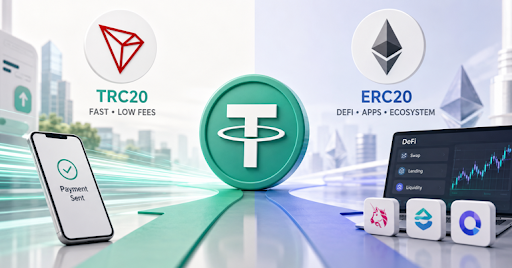
Two users can send the same amount of USDT and still have a different experience. One transfer may arrive quickly with a small fee, while another can become more expensive depending on the network behind it. The difference comes from the blockchain used for the transaction.
For anyone using USDT for payments, exchange transfers, or international transactions, choosing between TRC20 and ERC20 has become part of managing digital assets.
Why USDT Network Choice Matters for Digital Payments
Once USDT leaves a single exchange, the underlying network shapes the entire flow: fees, confirmation time, wallet compatibility, and what you can do with the token next.eco+1
On TRON, USDT on TRC20 usually moves alongside TRX, which pays for network fees. Users often need to convert between USDT and TRX when shifting between Tether payments and other TRON-based activity. Platforms like ChangeNOW support this workflow, allowing users to swap USDT to TRX as part of that process.
In practice, the choice often comes down to the destination:
- Exchange transfers: TRC20 is widely supported for USDT withdrawals and wallet‑to‑wallet payments where cost and speed matter most.
- Ethereum applications: ERC20 remains necessary for DeFi platforms, DEXes, and other Ethereum-based services.
- Payment flows: Businesses and individuals typically pick the network that aligns with their existing tools and counterparties.
As stablecoins become part of everyday transfers, network selection has moved from a technical detail to a practical step in managing digital payments.
USDT TRC20: Why It Became the Go‑To for Transfers
TRC20 gained dominance because it offered a noticeably cheaper and faster way to move USDT compared with most Ethereum-based transfers. Built on the TRON blockchain, it is now the backbone of stablecoin remittances, exchange withdrawals, and P2P payments.
For routine transfers between exchanges and wallets, users default to TRC20 when both sides support it. Lower fees compound quickly, especially for frequent or smaller transactions. The same logic applies to cross‑border payments, where speed and predictable costs are critical.
Current 2026 benchmarks show TRC20 transfers typically costing $0.50–$2 and confirming in seconds to a few minutes, depending on the exact path and whether the recipient wallet has held USDT before.
The trade-off is clear: TRC20 is optimized for moving value, not for rich application ecosystems. If you need DeFi protocols, complex smart contracts, or deep Ethereum integration, you’ll still rely on ERC20.
USDT ERC20: Why Ethereum Still Matters for Tether
ERC20 USDT serves a different role. While TRC20 is often about efficient transfers, Ethereum-based Tether remains essential because it lives on the largest smart-contract ecosystem.
Users reach for ERC20 when they need USDT inside:
- Decentralized exchanges (e.g., Uniswap, Curve)
- Lending and borrowing protocols (e.g., Aave, Compound)
- Liquidity pools, yield strategies, and other DeFi primitives
The downside is higher and more volatile transaction costs. In 2026, a standard ERC20 USDT transfer typically costs $3–$15 in normal conditions and can spike to $30–$35+ during congestion, paid in ETH from the sender’s wallet.
For users who require access to Ethereum’s infrastructure, ERC20 remains the default, despite the fees.
Choosing the Right Network for Different Use Cases
The choice usually comes down to what happens after the transfer. A network that works well for sending funds between wallets may not be the one required for interacting with blockchain applications.
Transfers between exchanges and wallets
For routine USDT movements, users often choose TRC20 when both platforms support it. This is common for exchange withdrawals and wallet-to-wallet payments where the primary goal is efficient fund movement.
DeFi and Web3 activities
ERC20 remains the preferred option for users who need USDT inside Ethereum-based applications. Decentralized exchanges, lending platforms, and liquidity services are built around Ethereum standards, making ERC20 compatibility essential.
Business payments
Companies may use different networks depending on the payment flow. A business sending USDT to a supplier might pick a network optimized for simple transfers, while a fintech product integrating blockchain services may require access to Ethereum infrastructure.
The differences between these networks become especially important when users move funds across platforms. Understanding USDT TRC20 vs ERC20 differences helps determine which option fits a specific transaction instead of treating all USDT transfers the same way.
Why Wallet and Exchange Support Matters Before Sending USDT
Even when users choose the right network for their needs, the transfer can still fail if the receiving platform does not support the same USDT standard.
Before sending funds, users should check three things:
- Whether the wallet or exchange accepts TRC20 or ERC20 USDT
- Whether the deposit address matches the selected network (TRC20 addresses start with T, ERC20 with 0x)
- Whether the platform has specific rules for deposits and withdrawals
For example, an exchange may allow users to withdraw USDT through TRC20, while the receiving wallet only supports ERC20 deposits. In this situation, selecting the wrong network can lead to delays or require additional recovery procedures.
As stablecoins become more common in payments and transfers, network compatibility is becoming a basic part of managing digital assets. It is no longer just a technical detail — it directly affects whether a transaction arrives smoothly.
How USDT Payments Could Evolve Beyond Crypto Exchanges
USDT is gradually moving into payment apps, wallets, and fintech services. As these integrations improve, users may no longer need to manage every technical detail behind a transfer.
A freelancer receiving USDT from an international client, for instance, could use a single financial app to receive funds and convert them into local currency without manually choosing networks or moving assets across several platforms.
Regulation will also shape how widely stablecoin payments can expand. Clearer rules can make it easier for companies to build compliant services, while stricter requirements may affect which products are available in different regions.
Over time, the network behind a USDT transaction may become less visible. The focus will shift toward whether payments are fast, reliable, and easy to use in everyday financial situations.
Choosing Between USDT TRC20 and ERC20 in Practice
The choice between TRC20 and ERC20 depends on the specific transaction rather than on one network being universally better.
Before sending USDT, users usually look at:
- Destination: wallet, exchange, or blockchain application
- Network support: whether the receiving service accepts the selected USDT version
- Future use: whether the funds will be simply transferred or used within a specific ecosystem
For example, a user moving USDT between exchanges may choose the network available on both platforms, while someone interacting with Ethereum-based services will need ERC20 support.
The most suitable network is the one that fits the purpose of the transfer and avoids unnecessary limitations afterward.
The Future of USDT Payments in 2026 and Beyond
USDT is gradually moving beyond crypto exchanges into payment tools, wallets, and financial services. The next stage of adoption will depend on whether stablecoin transactions can become as simple as traditional digital payments.
Users may eventually stop choosing networks manually. A fintech app or wallet could handle the technical side automatically, selecting the appropriate route based on availability, cost, and the destination platform.
Regulation will also shape how widely USDT can be used. Clearer rules and stronger infrastructure can encourage more companies to integrate stablecoin payments, while uncertain requirements may slow expansion in some markets.
The main challenge is no longer moving USDT between blockchains. It is making digital dollars easy to use in everyday financial activity without adding unnecessary complexity.
Choosing the Right USDT Network in 2026
TRC20 and ERC20 serve different purposes in the stablecoin market. TRC20 is often used for efficient transfers, while ERC20 remains important for Ethereum-based services and applications.
The broader trend is that network choice is becoming part of a larger payment infrastructure. As wallets and fintech platforms improve, users may focus less on technical details and more on whether transactions are fast, reliable, and simple.
The future of USDT payments will depend on solutions that make digital assets easier to use in everyday financial activity.
FAQ
What is the main difference between USDT TRC20 and ERC20?
TRC20 runs on TRON and is optimized for fast, low‑cost transfers. ERC20 runs on Ethereum and is required for DeFi, DEXes, and other smart‑contract applications.
Is USDT TRC20 cheaper than ERC20?
Yes. TRC20 transfers typically cost $0.50–$2, while ERC20 transfers usually cost $3–$15 and can spike higher during congestion.
Which USDT network is better for everyday payments?
For simple transfers between wallets or exchanges, TRC20 is usually better. Use ERC20 when you need USDT inside Ethereum-based apps or DeFi protocols.superswap+1
Can I send USDT TRC20 to an ERC20 wallet?
No. The receiving wallet or exchange must support the same network. Sending USDT to the wrong network can cause delays or loss of funds.
Will users need to choose between TRC20 and ERC20 in the future?
Possibly not. As wallets and payment apps mature, many will auto‑select the optimal network, hiding these details from end users.
Disclaimer:
This article is for informational purposes only and does not provide financial advice. Always verify network compatibility and transaction details before sending USDT, as crypto transfers involve risks, including potential loss of funds.