
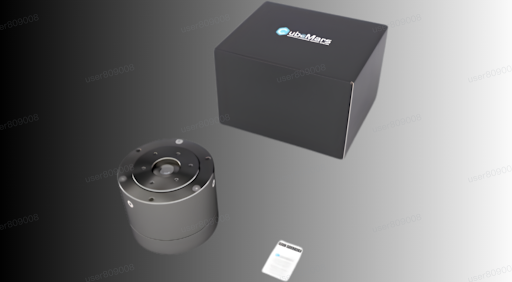
In the context of humanoid robotics, dual-arm grasping is one of the most advanced functions, which demands high precision for both arms as well as balance and coordination. From the use of precision instruments to moving boxes or conducting research, each joint needs to react correctly to the forces and commands of motion. The quality of the actuator system is a major contributor to the overall level of performance. Therefore, motor selection is a key issue in ensuring reliable, synchronized and natural motion in robotic systems.
1.Why Dual-Arm Grasping Demands Exceptional Motion Accuracy
Whereas single-arm manipulation involves only one joint, dual-arm grasping involves multiple joints working together at the same time. Moves of the shoulder, elbow, wrist and torso should be in sync and constantly adjusted to the position, weight and orientation of the object.
All movements require synchronized torque production, speed control and positional feedback. Even small time lags or asynchronisms between the joints can decrease the stability of grasping or influence the robot’s capability to perform complex manipulation tasks.
The humanoid robots thus require highly integrated actuator systems which are able to ensure smooth motion with a rapid response to dynamic changes. Responsiveness and high torque density provide the robot with the ability to lift, rotate and move objects without adding unwanted vibration and instability.
With the rapid integration of humanoid robots in research laboratories, medical applications, educational facilities, and service applications, the need for actuator systems that can provide repeatable motions under different operating conditions is growing.
2.Coordinated Joint Performance Improves Object Handling
For dual-arm manipulation to be successful, it is not only necessary to have motor power, but it also requires dexterous, coordinated, and synchronized actions. Each joint should provide controlled motion and be synced with all other actuators during the motion sequence.
High-quality robotic actuators combine several technologies into a compact package, including:
- Brushless DC motors for efficient power delivery
- Precision planetary gearboxes for torque multiplication
- High-resolution encoders for accurate position feedback
- Integrated drive electronics for simplified installation
- Multiple control modes supporting different robotic applications
This integrated architecture minimizes communication delay between each part and enhances the motion continuity of the whole robotic arm.
The advanced actuator modules also simplify wiring, making it easier for engineers to build lighter, more reliable and maintainable robotic arms.
3.How Humanoid Robot Motor Technology Supports Stable Dual-Arm Motion
The coordinated upper body movement is based on a high-performance Humanoid Robot Motor. Modern actuator modules have the motor, gearbox, encoder and drive electronics all combined in one compact package.
This integration brings some key benefits for dual-arm grasping. The high torque density ensures that the joints of a robot arm can have a high torque output while keeping the arm light. Lightweight design reduces inertia, which allows for accelerated movement and smoother deceleration when moving in a coordinated fashion.
Equally as important is accurate feedback. The dual encoder systems provide constant monitoring of joint position, allowing for very accurate corrections of the motion during grasping tasks. This level of feedback is particularly useful when moving objects that need precise positioning or a balance of forces.
Many of the advanced humanoid actuator solutions, such as the ones provided by CubeMars, also support both servo control and MIT hybrid control modes. These flexible control options enable developers to optimize the robot’s behaviour to the application, from gentle manipulation to dynamic whole-body motion.
Humanoid platforms are still in the process of developing the ability to interact more naturally with their environment, and integrated motor systems are essential for helping to create synchronized gait generation, balanced posture and synchronized arm movements.
4.Intelligent Control Features Enhance Grasp Precision
Even with mechanical performance alone, it is not possible to realize accurate robotic manipulation. Intelligent control systems give the software foundation that converts the actuator hardware to coordinated movement.
In modern actuator modules, there is also adaptive parameter identification, which means that the controller automatically learns the operating characteristics. This not only cuts down on commissioning time but also helps in assuring the same performance in all the robotic joints.
Additional protection mechanisms further improve operational reliability by monitoring:
- Overcurrent conditions
- Overvoltage and undervoltage
- Overheating
- Continuous operating status
In real-time monitoring, robotic systems may be able to keep their performance stable during challenging manipulation tasks, all while safeguarding critical actuator components.
Some actuator platforms also offer one-click mode switching between different modes of operation, making development easier for researchers and robotics engineers using the actuators in multiple applications.
5.Selecting the Right Robot Joint Motor for Upper and Lower Limb Coordination
Each Robot Joint Motor in a humanoid platform has a different function based on prioritization. Responsive movement and fine positioning of the upper limb joints are used for tasks involving the manipulation of objects, whereas high torque support, balance and stability are provided by the lower limb joints during walking or lifting.
In shoulder and elbow applications, high torque deminimizingact actuators can be used to achieve smooth arm trajectories and reduce robot weight. Smaller actuator modules that operate quickly while providing a compact installation size are ideal for wrist joints.
Lower limb actuators generally need a higher torque rating to carry the weight of the body and to move the body dynamically, for example, stepping, squatting, or lifting loads. Higher gear reduction ratios allow the low speed operation with a high output torque for challenging locomotion.
There are also some modern actuator modules with hollow shafts that can be used for internal cable routing. In this setting, the interference from the cable-organizing joints is minimized, and the mechanical organization of complex multi-joint humanoid systems is enhanced.
Multiple actuator sizes allow the robotic designer to select an actuator for each joint that can best meet the motion requirements, instead of using one actuator configuration throughout the robot.
6.Compact Integration Simplifies Humanoid Robot Design
Installation efficiency is an important engineering consideration because humanoid robots have many moving joints. Highly integrated actuator modules simplify assembly while bringing together all the key drive components in a compact package.
Engineers can use complete actuator modules that eliminate the need for separate motor, gearbox, encoder and controller mounts and electrical connections.
This integrated approach provides several engineering benefits:
- Reduced overall robot weight
- Simplified mechanical assembly
- Improved cable management
- Higher system reliability
- Easier maintenance and replacement
CubeMars has been concentrating on integrated robotic actuator development for applications such as humanoid robots, exoskeletons, robotic arms and industrial automation. These mechanical and control systems are small and powerful, allowing engineers to create more agile and efficient robotic platforms.
7.Future Advancements Continue Expanding Humanoid Manipulation Capabilities
With the continuous development of humanoid robotics, the function of dual-arm manipulation is expected to be expanded beyond pick-and-place. In the future, robots will be increasingly required to coordinate assembly, support in the medical field, laboratory automation, material handling in warehouses, and service tasks in cooperation with people.
These demands can only be met by actuator technologies that offer higher torque density, faster response, higher positional accuracy and higher energy efficiency, while simultaneously reducing system size and weight.
Advanced IDEs, encoder technology, intelligent control algorithms and light construction of actuators will continue to enhance the dexterity of robots and the simplicity of system architecture. As humanoid robots perform more complex motions in dynamic environments, multi-actuator communication and adaptive coordinated joint synchronization are likely to be increasingly important.
Conclusion
Fingers’ grasping ability requires much more than mechanical power. It demands that all robots provide coordinated motion, responsive torque, accurate positional feedback and stable control throughout the manipulation process. These capabilities are all integrated into one compact package in highly integrated actuator systems, which enhance both the performance of the robot and engineering efficiency.
In the future, advanced actuator technologies will continue to play a key role in the successful implementation of natural motion and reliable object manipulation in the ever-growing field of humanoid robotics in research, service, education, healthcare and industry. By choosing motor systems that are well integrated, have high torque density, intelligent controlled and provide precise feedback, the base for creating humanoid robots for performing more and more complex dual-arm tasks with confidence and consistency is strong.