
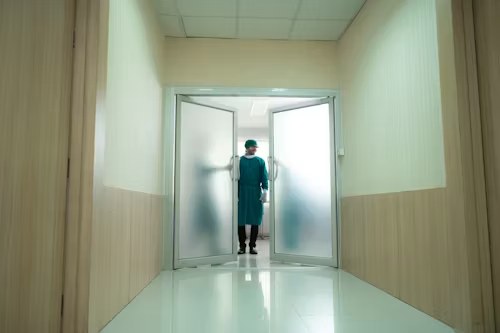
Healthcare facilities depend on doors for much more than basic entry and exit. Automatic entrances must support patients with limited mobility, allow staff to move equipment efficiently, help control access, and withstand constant use without creating safety concerns. A dependable automatic door service for healthcare should address installation, inspection, preventive maintenance, emergency repairs, accessibility, security integration, and infection-control considerations. Hospitals, clinics, rehabilitation centers, senior care communities, and medical offices each have different traffic patterns and operational risks. The right service program considers how every opening is used rather than treating all automatic doors as identical equipment. With planned care, facilities can reduce disruptions while maintaining safer and more convenient movement throughout the building.
Why Healthcare Automatic Doors Require Specialized Service
Healthcare doors operate in conditions that are often more demanding than those found in standard commercial buildings. Patients may approach slowly, use mobility devices, or require assistance from caregivers, while staff may move stretchers, wheelchairs, carts, and sensitive equipment through the same opening. Emergency departments and main entrances may also experience unpredictable traffic surges throughout the day. AAADM guidance notes that healthcare door selection should consider facility layout, user types, traffic density, expected abuse, safety, and security requirements. These variables make healthcare door service a specialized discipline rather than a routine maintenance task.
A malfunctioning door can interrupt clinical workflows even when it does not fail completely. A delayed sensor may force staff to stop while transporting a patient, while an improperly adjusted door may begin closing before slower users have cleared the opening. Doors connected to access-control systems can create additional problems if locks, credentials, alarms, or emergency-release functions do not communicate properly. Even minor scraping, vibration, or inconsistent movement may indicate a developing mechanical problem. Specialized technicians understand that service decisions must account for patient safety, accessibility, infection prevention, security, and business continuity. That broader perspective is essential in an environment where door performance can affect both care delivery and facility operations.
Automatic Door Installation and Replacement
Professional installation is the foundation of a reliable automatic door system. The installer must evaluate the opening size, expected traffic, available clearances, door weight, activation method, surrounding surfaces, and applicable building requirements. Healthcare facilities may need sliding, swinging, folding, low-energy, touchless, or specialty door systems, depending on the location. Main entrances often prioritize high traffic capacity, while patient rooms may require hands-free operation and controlled movement. Selecting the wrong operator or sensor configuration can create recurring maintenance problems even when the equipment is technically functional.
Replacement services are equally important because older doors may no longer support the facility’s operational needs. Aging systems can become difficult to repair when components are obsolete, damaged, or incompatible with newer safety devices. A qualified provider should compare the cost of continued repair with the long-term value of replacing the operator, control system, sensors, or complete assembly. Replacement planning should also address downtime, temporary access routes, electrical requirements, security connections, and clinical scheduling. In active healthcare environments, installation work often must be phased to preserve patient and staff access. A planning-first approach helps prevent a door project from becoming an avoidable operational disruption.
Preventive Maintenance for High-Traffic Entrances
Preventive maintenance allows technicians to identify wear before it leads to a sudden failure. During a scheduled visit, the provider may inspect rollers, pivots, belts, tracks, arms, fasteners, wiring, controls, sensors, guides, seals, and other system-specific components. The technician can clean debris from operating areas, tighten loose hardware, lubricate appropriate components, and correct developing alignment problems. Preventive service should also include full operational testing rather than focusing only on visible mechanical parts. This helps the facility confirm that the opening, hold-open, closing, and reactivation cycles remain consistent.
Service frequency should reflect actual door use and environmental conditions. A main hospital entrance that cycles thousands of times per day may need more frequent maintenance than a low-use administrative doorway. Emergency departments, loading areas, pharmacies, surgical corridors, and rehabilitation spaces can also place unusual demands on operators and sensors. Facilities should work with the service provider to establish intervals based on cycle counts, manufacturer recommendations, repair history, and observed wear. Maintenance records can then be reviewed to identify doors that are generating repeated service calls. This information helps facility managers plan repairs and capital replacements more accurately.
AAADM Inspections and Daily Safety Checks
Automatic pedestrian doors should receive regular safety inspections from a properly qualified professional. AAADM recommends inspection immediately after installation and annually thereafter by an AAADM Certified Inspector. These inspections allow the inspector to identify adjustments or repairs needed to bring the door into alignment with applicable industry standards. The evaluation may cover activation, sensor detection, door speed, closing force, timing, signage, emergency operation, and the physical condition of the surrounding opening. Annual inspection documentation also gives healthcare facilities a consistent record of safety-focused oversight.
Professional inspections do not replace daily safety checks conducted by the facility. AAADM encourages premise owners to safety-check automatic doors daily so that operational problems can be recognized between annual inspections. Employees responsible for these checks should receive instructions for each door type because the correct procedure can vary. A door that hesitates, closes unexpectedly, makes unusual sounds, or fails to detect a person should be removed from automatic operation when continued use could be unsafe. Staff should also know how to report the condition and contact the appropriate service provider. Proper installation, annual inspection, daily checks, and timely maintenance work together as parts of the same safety process.
A daily review may include checking for:
- Reliable activation from normal approach directions
- Proper detection of people within the doorway
- Smooth opening and closing movement
- Appropriate hold-open time
- Unusual noise, vibration, hesitation, or impact
- Loose mats, carts, displays, or equipment near sensors
- Missing or damaged safety decals
- Broken glass, loose hardware, or damaged door panels
Sensor Testing and Calibration
Sensors are among the most important components in a healthcare automatic door system. They may activate the door as a person approaches, monitor the threshold, or prevent the door from closing while someone remains in the path. Sensor coverage must account for patients who walk slowly, stop unexpectedly, use wheelchairs, or travel alongside caregivers. Technicians should test detection from relevant directions and at different points in the operating cycle. A sensor that opens the door successfully may still require adjustment if it does not monitor the necessary safety area.
Changes around the doorway can also affect sensor performance. New floor finishes, reflective materials, temporary signs, furniture, medical equipment, and construction barriers may alter how a sensor detects movement or presence. Technicians should evaluate the environment rather than assuming every detection problem is caused by a defective sensor. Calibration may involve repositioning equipment, adjusting fields, updating control settings, cleaning lenses, or replacing damaged components. Facility staff should avoid making undocumented sensor adjustments because one change can affect another safety function. Any recurring activation problem deserves professional investigation.
Touchless Activation and Infection-Control Support
Touchless door systems can reduce the number of surfaces people must contact while moving through a healthcare facility. Motion sensors, wave-to-open switches, touchless wall devices, and automated sliding doors may be useful at public entrances, patient rooms, staff corridors, restrooms, and controlled clinical areas. These systems do not replace a healthcare facility’s broader infection prevention and control program, but they can support workflows designed to reduce unnecessary contact. CMS requires participating facilities to maintain infection prevention and control programs that provide safe and sanitary environments. Door hardware and activation methods should therefore be considered within the facility’s larger environmental strategy.
Automatic door service should also include cleaning and maintenance considerations for touchless equipment. Sensor covers, switches, door panels, handles, and control surfaces may be exposed to frequent cleaning products. The provider should confirm that cleaning methods do not damage lenses, seals, labels, wiring, or electronic components. Maintenance teams should also coordinate with infection prevention personnel before replacing materials or changing operating methods in sensitive areas. In procedural, isolation, or pharmaceutical environments, airflow and pressure relationships may need to be considered before door timing is altered. Service technicians should never make convenience-based adjustments without understanding how the doorway supports the surrounding clinical space.
Accessibility and Low-Energy Door Services
Healthcare facilities serve many people who cannot open or pass through conventional doors easily. Low-energy operators and automatic doors can improve access for wheelchair users, people with walkers, patients recovering from procedures, and caregivers carrying supplies. Service providers should confirm that activation devices are reachable, visible, responsive, and located along practical approach paths. The door must also remain open long enough for the intended users to pass through safely. Accessibility depends on the entire path of travel, not just the presence of an automatic operator.
A doorway can become difficult to use when floor mats shift, thresholds become damaged, activation buttons are blocked, or nearby furniture restricts maneuvering space. Regular service should therefore include observation of the surrounding approach and clearance areas. Technicians may also need to coordinate with accessibility consultants, architects, or facility managers when an opening is being renovated. Automatic operation should complement the building’s accessibility plan instead of compensating for an unsuitable layout. Healthcare organizations should also evaluate whether backup operation remains practical during a power interruption. Reliable access must be considered under both normal and emergency conditions.
Security and Access-Control Integration
Healthcare doors frequently connect to card readers, electric locks, intercoms, alarms, infant-protection systems, staff credentials, and security-management platforms. These integrations can restrict unauthorized entry while allowing approved staff to move quickly between departments. Joint Commission guidance recognizes that healthcare organizations may lock specific areas to protect medications, hazardous materials, pediatric patients, obstetrical units, and other vulnerable populations. Security arrangements must be based on facility circumstances and a documented risk assessment. Automatic door technicians should coordinate closely with security, life-safety, and access-control professionals when servicing connected openings.
Integrated testing should confirm more than whether a card reader unlocks the door. The service provider may need to verify door sequencing, delayed egress functions, alarm reporting, emergency release, operator response, and behavior during a power or network failure. Changes made by one contractor can unintentionally affect another part of the system. For example, replacing a lock without reviewing operator timing may cause the door to pull against secured hardware. Healthcare facilities benefit from clearly assigning responsibility for each integrated component. Detailed records help technicians troubleshoot problems without relying on trial and error.
Emergency Repairs and Rapid Response
Automatic door failures cannot always wait for the next scheduled maintenance visit. An entrance that will not open may restrict patient access, while a door that will not close can create security, environmental, and operational problems. Healthcare facilities should establish an emergency service process with clear contact information, escalation procedures, and authorization rules. The provider should understand which doors are mission-critical and which alternative routes can be used temporarily. This preparation can reduce confusion during an actual failure.
Staff should be trained not to repeatedly reset, force, or adjust a malfunctioning system. Improvised repairs can damage the operator or create an unsafe condition that is harder to diagnose later. When appropriate, the door should be shut down, secured, or placed in an approved manual mode until a qualified technician arrives. The technician should document the cause, repair performed, parts replaced, and follow-up recommendations. Repeated emergency calls for the same opening should trigger a deeper evaluation. The facility may need a redesigned system, upgraded components, or a revised preventive maintenance interval.
Frequently Asked Questions
How often should healthcare automatic doors be serviced?
Service frequency depends on traffic, equipment type, manufacturer recommendations, and operating conditions. High-cycle hospital entrances may need preventive maintenance several times per year.
Are annual automatic door inspections necessary?
AAADM recommends an inspection after installation and annually thereafter. Local codes, contracts, accreditation expectations, or facility policies may establish additional requirements.
Who should inspect an automatic pedestrian door?
An AAADM Certified Inspector should perform safety inspections based on the applicable automatic pedestrian door standard. General maintenance personnel may conduct daily checks, but should not substitute those checks for professional inspection.
Can automatic doors support infection-control efforts?
Yes, touchless doors and activation devices can reduce unnecessary surface contact. They should be used as part of a broader infection prevention program rather than as a standalone solution.
What should staff do when a door behaves unpredictably?
Staff should report the issue immediately and prevent automatic use when continued operation may be unsafe. A qualified technician should test the system before it returns to service.
Do access-controlled automatic doors require specialized maintenance?
Yes. The operator, lock, credential system, alarms, sensors, and emergency-release features must function together correctly.
When should an automatic door be replaced instead of repaired?
Replacement may be appropriate when parts are obsolete, failures are frequent, safety upgrades are impractical, or repair costs are no longer economical. A lifecycle assessment can help the facility compare the available options.
Creating a Complete Healthcare Door Service Program
A successful door program begins with a complete inventory of automatic openings across the facility. Each record should identify the door type, location, manufacturer, operator, safety devices, access-control connections, inspection dates, service history, and responsible department. Facility managers can then classify doors according to traffic, clinical importance, security risk, and consequences of failure. This makes it easier to prioritize preventive maintenance and plan replacements before equipment reaches the end of its practical service life. Standardized documentation also improves communication among maintenance teams, security staff, clinicians, administrators, and outside contractors.
The best automatic door service for healthcare combines technical expertise with an understanding of patient movement and clinical operations. Installation, inspections, sensor calibration, preventive maintenance, accessibility support, security integration, touchless upgrades, and emergency repairs should be coordinated through one organized strategy. Daily checks can identify immediate concerns, while recurring professional service helps manage gradual wear and changing facility conditions. Healthcare leaders should select providers that document their work, understand applicable standards, and communicate clearly about safety-related deficiencies. With a proactive service plan, automatic doors can continue supporting safe access, efficient workflows, and dependable care throughout the facility.