
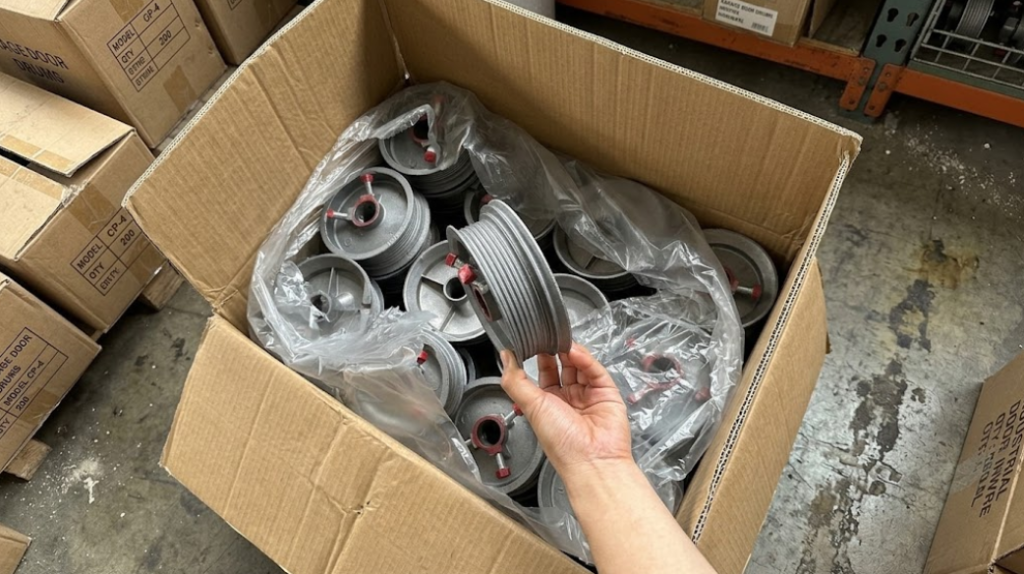
Powerful springs and sturdy tracks aren’t enough for big sectional garage doors. The lifting system should also control the movement of the cable, ensuring it moves in a controlled and repeatable manner throughout the entire travel of the door. The larger the door size, weight, and lift configuration, the more important it is to choose the right drum to ensure balanced operation and consistent mechanical performance.
The challenge for manufacturers, distributors and installation professionals doesn’t stop there: selecting the correct component. Large door projects frequently demand a number of models, dimensional reliability, matching cable sizes, and a supplier who can handle repeat orders. These requirements can be managed more easily by adopting an OEM-ready approach, which combines standardized engineering with practical customization and scalable manufacturing.
1.Understanding the Role of the Drum in Large Door Systems
A cable drum is an essential part of a torsion spring lifting system. The drum can wind or unwind the lifting cable as the shaft rotates, transforming the rotation of the spring into controlled vertical motion of the door. The cable’s groove shape, diameter, hub size, and cable type all have an impact on the consistent operating travel of the cable.
With large doors, this function is particularly relevant as the height and weight of the door may impose additional demands on the lifting assembly. A well-fitted garage door drum will direct the cable in the path in which it is supposed to wind, and will ensure that the garage door moves smoothly between the two sides.
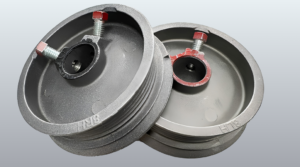
Important selection factors include:
-
Door height and approximate door weight
-
Standard, high-lift, or vertical-lift configuration
-
Compatible cable diameter
-
Drum diameter and winding range
-
Torsion shaft and hub compatibility
-
Required lifting capacity for the intended application
Choosing according to these parameters prevents the drum from being treated as a generic hardware item. Instead, it becomes a deliberately matched part of the complete lifting system.
2.Matching Drum Geometry to Different Lift Configurations
Not all large garage doors operate in the same manner. The standard lift type doors move vertically then horizontally, but the high lift type doors go up further before moving horizontally. Vertical-lift doors travel significantly upwards with little or no horizontal track section.
These differences have a direct impact on the cable winding requirements. It is not a valid assumption that a drum that is used for one lift arrangement could be used for another. The geometry of the groove and the effective winding diameter must match the door’s motion.
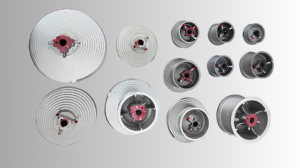
Typically, the standard lift models are used for standard residential and light commercial applications, whereas high-lift and vertical-lift drums are used for special commercial configurations. Depending on the type of drum used and the specific system requirements, available ranges can range from smaller standard-lift applications to models designed to lift doors to about 28 feet or higher.
The obvious benefit of having a wide selection of models is that the manufacturer can order parts based on the actual size of the door rather than trying to fit various uses into a single “catch-all” drum.
3.Material, Groove Accuracy, and Mechanical Consistency
If the drum needs to be able to endure multiple loads, material selection is important. These are typically made from high-strength cast aluminum since they have a useful structural strength while maintaining relatively low component weight. Material is not the only factor in performance, though.
The casting quality and subsequent machining quality are also important. Properly formed grooves ensure that cable remains in place during drum winding. Sustained hub size ensures secure placement on the torsion shaft, and well-controlled machining tolerances ensure repeatability from one production batch to the next.
Consistency is especially important for mass manufacturing applications since a part that isn’t the same from batch to batch can lead to fitting and inventory issues.
A dependable production process should therefore emphasize:
-
Structural consistency with controlled casting.
-
Correct cable guidance geometry.
-
Machined hubs for secure fit on shaft
-
Positioning set screws that are hardened.
-
Left and right identification as clear as appropriate
Each of these details may seem minor on its own, but they all work together to ensure that the door can be assembled and operated in a predictable and repeatable manner.
4.OEM Readiness for Large and Mixed-Model Orders
With large door projects, it is often necessary to use more than a single drum specification. A manufacturer might have standard lift components for one product line, high lift components for another product line, and vertical lift components for larger commercial systems. OEM readiness implies that the supplier is able to support these differences without compromising consistency.
A good manufacturing program can deliver:
Model Selection: Drum ranges for various door heights, weights, cable sizes, and lift types.
Customization: Private labeling, custom marking, packaging formats, and chosen drum configurations are a few options that may help harmonize components with an OEM’s internal product structure.
Production Control: Critical dimensions and groove characteristics can be monitored throughout production due to in-house casting, CNC machining, and finishing.
Order Flexibility: Mixed-model shipments make it possible to mix a number of drum specifications in a larger hardware procurement program.
This combination of engineering range and production capability enables Gemax to produce cable drums as part of the larger OEM supply programmes instead of only being sold as a single replacement part.
5.Building a Reliable Supply Strategy for Large Door Projects
Procurement is not just a matter of technical compatibility. Predictable availability, clear identification and packaging that facilitates efficient warehouse and installation processes are also essential for large projects.
An OEM supplier should be able to ensure continuity of production on models that are frequently requested, and accept repeat orders and changing project needs. It’s also handy if several drums appear identical, but are meant for different lift or door height combinations.
Packaging can also be geared toward the purchasing structure. Drums can be provided as single drums, as drum sets of the same model, or as drums within a hardware package with associated torsion-system parts. This can make inventory management easier and minimize the chances of assembly problems between incompatible parts.
For repeated projects, documentation and model cross-referencing are valuable as well. Specifications such as door height, weight, type of lift, and cable diameter provide tangible criteria for purchasing teams and technicians to choose the right component, rather than relying on visual similarity.
Conclusion
Large garage door projects need a drum strategy that focuses on engineering compatibility, manufacturing consistency, and scalable supply. Standard lift, high lift, and vertical lift systems each impose different cable-winding configurations, and selecting the proper model is critical to ensure proper and reliable door operation.
OEM-ready drums provide an additional value for manufacturers, providing consistent drum dimensions, wide drum coverage, customisation options, and mixed order flexibility. These capabilities, along with controlled casting and machining, make the drum more than just a replacement part; it’s a reliable component for full door systems.
In large residential, commercial, and industrial door programs, picking the correct drum from the start can make assembly easier, help ensure more supply security, and ensure consistent performance during repeated installations.