
The useful question is not whether a creator tool is free or expensive. It is whether the workflow needs less manual effort, better evidence or stronger coordination—and whether that improvement is worth paying for.
A free stack can be enough for a focused solo creator. A paid platform can be worthwhile for a team that needs approvals, reporting and cross-channel oversight. Neither software nor spend guarantees audience growth. The decision should rest on measurable workflow value, not feature counts or a larger follower number.
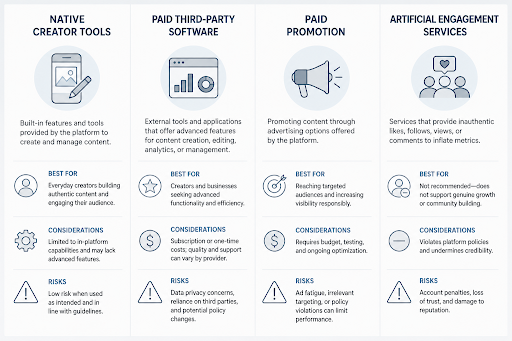
Four categories that are often confused
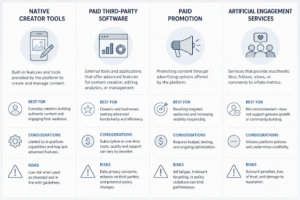
Different creator-growth categories solve different problems and should not be treated as substitutes.
| Category | Primary purpose | Typical output | Main limitation or risk |
|---|---|---|---|
| Native creator tools | Create, publish, manage and review content | First-party publishing and performance signals | Features and eligibility vary |
| Paid third-party software | Organise workflow and consolidate analysis | Scheduling, reporting, permissions and dashboards | Data coverage and useful features vary by plan and integration |
| Paid promotion | Buy distribution toward a selected objective | More opportunities for views or actions within a budget | It does not prove organic loyalty or business results |
| Artificial follower or engagement services | Inflate visible account metrics | A larger displayed count | Policy, credibility and measurement risks |
Treating these as substitutes produces poor decisions. Scheduling software does not buy an audience. Advertising does not guarantee a returning audience. And a visible follower increase is not, by itself, evidence of qualified viewers, leads or sales.
Start with the native stack
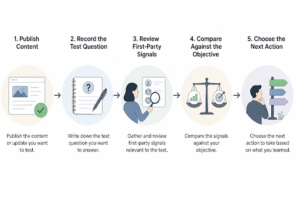
A lightweight content log can turn free tools into a repeatable learning system.
For many beginners, TikTok Studio is the practical starting point. TikTok describes its creator tools as covering content upload, scheduling, editing, management and analysis, as well as comment management, creative inspiration, growth resources and monetisation information. Studio analytics can include account-level metrics, individual content performance and follower demographics.
As noted in TikTok’s creator tools documentation, feature availability can differ by region, account eligibility and whether a creator uses the app or web experience. Retrieved September 16, 2026. The same caution applies to monetisation and collaboration features: access can depend on region, account type, product surface, account standing, eligibility requirements and current TikTok policy.
A capable free-first stack is simple:
- TikTok Studio for publishing and first-party performance review.
- A content calendar, however basic, for formats, hooks and publishing dates.
- An asset folder for reusable footage, scripts and approved creative.
- A spreadsheet that records the question tested, the post, the result and the next action.
The objective is not to collect every metric. It is to answer useful questions: Which opening earns more sustained attention? Which topic drives profile visits? Which format produces saves or qualified enquiries? Review follower count alongside retention, watch time, saves, shares, profile visits, qualified followers, leads, sales and repeat engagement.
A link advertised as free TikTok followers is best treated as an optional reference to a follower-related offer, not as part of an analytics or publishing stack. Before using any such offer, establish what it does, what account access it requests and whether its claimed outcome supports the real goal. A displayed count alone is not a decision metric.
What paid software can solve
Paid creator software is most defensible when it removes a repeatable bottleneck. Depending on the product, plan, connected accounts and regional support, this may mean more scheduling capacity, a shared calendar, cross-platform reporting, exports, approval workflows, user permissions or support.
Those are operational gains, not growth promises. A dashboard cannot make a weak idea resonate. It may, however, help a team publish on time, preserve approval records and compare content consistently enough to make quicker decisions.
The difference is clearest in a team workflow. A creator posting twice a week to one account may not need anything beyond native tools and a spreadsheet. A business working across several channels with a freelance creator, manager and client may need defined roles, approval steps and reporting that does not require copying data between systems.
Third-party analytics should never be assumed to equal native TikTok reporting. What a provider can show may differ because of account authorisation, granted permissions and scopes, API availability, regional restrictions, reporting delays and the provider’s implementation. Confirm the actual TikTok connection, supported metrics, export options and posting capabilities for the specific accounts before purchase.
Current vendor terms are also volatile. As one point-in-time example, Buffer’s pricing page listed a free tier, limits on channels and scheduled posts, and 30-day analytics history; its paid plans listed expanded scheduling, analytics, team access and approval features. Retrieved September 16, 2026. These details are not a market benchmark and may change; verify live pricing, billing model, trial terms, taxes, cancellation rights and plan limits before committing.
The real costs of free and paid
Free tools do not automatically create a problem. Manual reporting is sensible when it takes minutes and informs a useful decision. It becomes costly when a team repeatedly rebuilds the same report, loses context between channels or waits for approvals that could be handled in a structured workflow.
Paid tools carry their own costs: recurring fees, onboarding time, unused functionality, changing plan limits, account-permission decisions and data-retention concerns. A trial is valuable only if it tests one defined constraint—for example, whether a shared approval process reduces late publishing, or whether consolidated reporting removes a recurring manual task.
A maturity matrix for upgrading
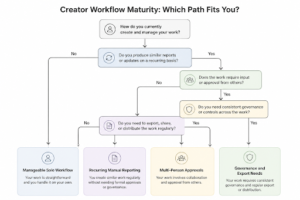
Upgrade decisions should follow repeatable operational bottlenecks, not follower count alone.
| Stage | Suitable starting capability | Upgrade trigger | Metrics to monitor |
|---|---|---|---|
| Beginner | Native tools, content log, asset folder | Publishing or learning is inconsistent | Output, watch time, profile visits |
| Growing creator | Native tools plus a repeatable testing process | Manual reporting or multi-platform posting recurs | Retention, saves, shares, qualified followers |
| Professional creator | Structured calendar and conversion tracking | Client reporting or collaborator handoffs become routine | Leads, sales, repeat engagement, partnership outcomes |
| Agency | Shared workflow and account-level reporting | Permission, approval and export needs create risk or delays | Client outcomes, turnaround time, reporting accuracy |
| Brand team | Role-based access and measurement standards | Multiple stakeholders require governance | Decision speed, operational quality, business outcomes |
This is a guide, not a ladder every account must climb. A creator with one high-value client may need reporting sooner than a larger account without commercial obligations. Conversely, a team may buy permissions and approvals for governance rather than analytics depth.
Calculate upgrade value before paying
Use a simple decision model:
Estimated monthly upgrade value = (hours saved × internal hourly value) + measurable workflow or business impact − monthly tool cost.
This is an illustrative formula, not an industry benchmark. For example, if a $30 monthly tool removes two hours of reporting work and that time is valued at $20 per hour, its time component is $40. It passes the narrow time test before considering fewer reporting errors or faster decisions.
Keep the impact term disciplined. Do not assign revenue to a tool merely because it was installed. During a trial, compare the old and new workflow: time spent, report completion, approval delays, errors found, decisions made and any trackable action that followed. If no meaningful improvement appears, stay free.
Paid promotion is different from artificial engagement
TikTok Promote is an in-app advertising tool that can amplify videos and LIVE content using selected objectives, budgets, durations and audiences. Its objectives can include video views, followers, profile views, website visits, leads, sales and LIVE views. TikTok’s Promote documentation explains the available campaign controls; retrieved September 16, 2026.
Promote buys distribution opportunities. It does not establish that viewers will return, become customers or respond to subsequent organic posts. Judge a promotion by the objective selected and post-campaign evidence: watch behaviour, profile visits, lead quality, purchases where measurable, and subsequent retention—not merely delivered views.
Artificial follower or engagement services are a separate category. TikTok’s Integrity and Authenticity rules prohibit trading or marketing services that artificially increase engagement or deceive its recommendation system. TikTok says it may remove fake followers or likes, make manipulated content ineligible for the For You feed, and take action against deceptive account behaviour.
A followers service should therefore be understood as a follower-growth service, not analytics software, a scheduler or TikTok advertising. It is an optional reference, not an endorsement or a claim about effectiveness, safety or policy compliance. Assess any such service against the live platform rules, the relevance of the resulting audience and the account’s actual conversion objective.
Check before connecting an account
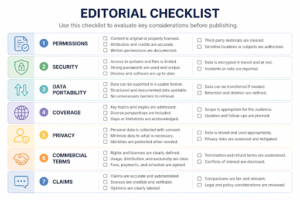
Review access, data handling and commercial terms before authorising third-party software.
Before authorising third-party software, review:
- Permissions: Is the requested access necessary, and can it be revoked?
- Security: Can collaborators receive role-based access rather than sharing a password?
- Data portability: Can reports and operational records be exported?
- Coverage: Which metrics are native, delayed, estimated or unavailable?
- Privacy: What data is stored, for how long and under which terms?
- Commercial terms: Are renewals, cancellation, taxes, regional availability and support clear?
- Claims: Does the provider distinguish workflow features, paid distribution and outcomes it cannot control?
Decision checklist and practical stacks
Stay free when:
- Native tools answer the questions that guide the next content decision.
- Publishing and reporting are manageable without recurring delays.
- One person can safely manage the account and assets.
- There is no clear, repeated bottleneck to solve.
Test a paid plan when:
- The same manual reporting or scheduling task recurs each month.
- You need to validate a specific feature, such as exports, approvals or cross-channel views.
- A trial can be measured against a defined baseline rather than explored casually.
Upgrade now when:
- Delayed approvals, fragmented data or access-control gaps repeatedly affect delivery.
- The time saved and operational value exceed the recurring cost.
- The team will use the added capability consistently and can preserve data if it changes vendors.
For a solo creator, keep the stack lean: TikTok Studio, a content calendar, an asset library and a simple results log. Add paid software only for a proven recurring need, such as multi-platform scheduling or client-ready reporting.
For a team, build around governance: first-party access where possible, named user permissions, an approval workflow, a shared content calendar, regular exports and a reporting template tied to business goals. Paid software earns its place when it makes that system more reliable.
The durable approach is free first and outcome-led throughout. Pay for clearer decisions, repeatable operations and accountable collaboration—not for feature volume, vanity metrics or promises no tool can responsibly make.