
The most fundamental law of plumbing is incredibly simple: water flows downhill. For thousands of years, human sanitation has relied almost entirely on the predictable, free energy of gravity to carry waste away from our homes and cities.
But what happens when the laws of topography are against you? What happens when a developer builds a sprawling new subdivision in a low-lying valley, a commercial park sits below the municipal sewer line, or a homeowner decides to install a full bathroom in their basement?
When you cannot rely on gravity, you have to fight it. You have to physically force thousands of gallons of raw wastewater uphill. This monumental task falls to a hidden, heavily engineered piece of infrastructure known as a lift station (or a sewage ejector system). For decades, these robust mechanical beasts have operated silently underground. Today, however, they are losing a massive, expensive war against a modern convenience: the “flushable” wipe.
The Architecture of Defying Gravity
To understand why a tiny cloth wipe can destroy heavy machinery, you must first understand how a lift station operates.
When a home or neighborhood sits below the main sewer line, all the wastewater flows downward into a large, subterranean concrete or fiberglass basin called a “wet well.” Inside this well sits a network of heavy-duty submersible pumps and a series of floating switches.
As wastewater fills the basin, the water level rises, lifting the float switches. When the water reaches a predetermined critical height, the float tips, sending an electrical signal to a control panel. The control panel roars to life, activating the submersible pumps. These pumps violently suck the wastewater from the bottom of the basin and force it up a pressurized, vertical pipe—known as a force main—until it reaches a high enough elevation to safely dump back into the municipal gravity sewer.
The Impeller: The Heart of the Machine
The absolute heart of this system is the pump’s impeller. Unlike a propeller on a boat that pushes water away, an impeller is a spinning metal rotor inside a casing (the volute) that uses intense centrifugal force to sling water outward and upward.
These impellers are engineered specifically to handle liquids and biological human waste, which naturally breaks down and dissolves in water. Traditional toilet paper is manufactured with short cellulose fibers designed to instantly disintegrate the moment they hit the water, passing harmlessly through the spinning blades of the impeller. Then came the modern wet wipe.
The “Flushable” Fiction
The marketing label “flushable” is one of the most destructive misnomers in modern plumbing. While a personal wipe will technically flush down the bowl and disappear from your sight, it absolutely does not behave like toilet paper once it enters the subterranean infrastructure.
Unlike toilet paper, modern wipes are manufactured using synthetic materials like polyester, rayon, and long-strand plastics. These materials are heavily woven to maintain their high tensile strength when wet. They are designed explicitly not to break down.
When hundreds of these indestructible wipes flow into a wet well, they are inevitably sucked into the submersible pump.
The Phenomenon of “Ragging”
When a synthetic wipe hits a spinning cast-iron impeller, it does not shred. Instead, the centrifugal force stretches and twists the wipe. When a second wipe enters, it twists into the first.
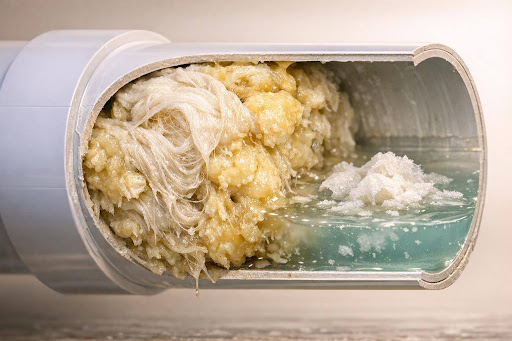
This creates a mechanical nightmare known in the wastewater industry as “ragging.” The synthetic wipes literally braid themselves together, forming incredibly strong, rope-like strands that wrap tightly around the pump’s drive shaft and impeller blades.
As the pump continues to spin, the rope of wipes acts like a tourniquet, growing thicker and tighter. The friction skyrockets. The electric motor, struggling to spin the bound impeller, begins to pull massive amounts of electrical current (amperage). The motor overheats, the thermal overload switches trip, and the massive pump violently shudders to a halt.
The Domino Effect of a Seized Pump
When the pump seizes, gravity immediately reclaims its territory.
The wet well continues to fill with incoming wastewater from the homes above, but nothing is being pumped out. High-water alarm sirens may trigger, but if the pump cannot clear the basin, the raw sewage will inevitably follow the path of least resistance. Usually, this means backing up into the lowest drains connected to the system—which are often the bathtubs and floor drains of the nearest residential basements.
Furthermore, the wipes that haven’t been sucked into the pump often mix with the fats, oils, and greases (FOG) poured down kitchen sinks. This mixture creates massive, buoyant concrete-like blocks known as “fatbergs.” These fatbergs float on the surface of the wet well, entangling and pinning down the electronic float switches, rendering the entire automated control panel blind to the rising water levels.
The Heavy-Duty Intervention
Fixing a ragged pump or a grease-locked wet well is not a job for a standard plumber with a snake. It requires highly specialized lift station services.
Technicians must arrive with industrial vacuum trucks to drain the toxic, overflowing wet well. They must use heavy mechanical hoists to physically lift the seized, several-hundred-pound submersible pumps out of the subterranean pit. Once on the surface, technicians must spend hours manually cutting the braided synthetic ropes off the impeller shafts with razor knives, testing the electrical limits of the burned-out motors, and recalibrating the complex control panels.
Conclusion
The infrastructure required to move water uphill is a marvel of modern engineering, allowing us to build communities in diverse and challenging topographies. However, these powerful machines have an Achilles’ heel. The momentary convenience of using a synthetic personal wipe is never worth the catastrophic mechanical failure, the environmental hazard of a sewage spill, or the thousands of dollars required to rebuild a burned-out pump. If you live in a home or a community that relies on fighting gravity, the rule is absolute: if it is not toilet paper, it belongs in the trash can.