
If you have ever stood on the shore and watched a modern Ultra Large Container Vessel (ULCV) glide out of a port, the visual geometry is almost entirely absurd. These massive ships carry up to 24,000 standard shipping containers. The boxes are stacked up to nine-high above the deck, creating a sheer vertical wall of corrugated steel that looks like a giant, precarious game of Jenga.
When the ship is in the calm, protected waters of a harbor, this vertical stacking makes sense. But the ocean is not a static environment. Once that ship hits the open water of the North Pacific or the North Atlantic, it will encounter winter storms, rogue waves, and hurricane-force winds.
The ship will violently pitch forward, roll violently from side to side, and heave up and down. So, when a ship carrying a wall of 40-ton steel boxes tips 30 degrees to the starboard side in the middle of a typhoon, why don’t the containers simply slide off the deck and into the abyss?
The answer is not gravity, and it is not massive ropes. The entire global supply chain relies on a remarkably simple, fist-sized piece of forged steel.
The Six Degrees of Motion
To understand the engineering required to secure a ship, you first have to understand the violence of the ocean. A vessel at sea moves in six distinct directions simultaneously.
The most destructive of these motions is the “roll.” When a ship rolls side to side, the containers at the very top of the stack experience a massive whipping effect. Furthermore, the rolling creates intense “racking” forces a diagonal stress that tries to crush the rectangular shape of the container into a parallelogram.
If the containers were just resting on top of one another, the friction of the steel would fail almost immediately. The boxes at the top would be catapulted into the sea, and the boxes at the bottom would be crushed under the shifting weight.
The Architecture of the Corner Casting
The foundation of container securement lies in the geometry of the box itself. Every standard shipping container features eight heavy, reinforced steel blocks at its corners, known as corner castings.
These castings have specific oval holes on the top, bottom, and sides. They are designed to act as universal connection points. When a crane stacks one container directly on top of another, the bottom oval holes of the top box align perfectly with the top oval holes of the bottom box.
However, aligning the holes does nothing to hold the boxes together. They need a mechanical bridge.
The Mechanics of the Cone
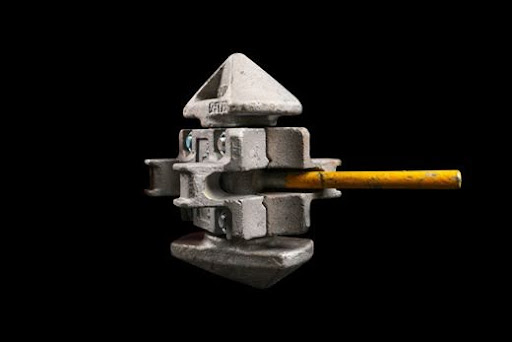
This is where the magic of the twist lock comes into play. Before a crane lowers a container onto the stack, dockworkers (often called lashers) insert a specialized piece of hardware into the bottom corner castings of the suspended box.
This hardware consists of a housing unit with a rotating, conical steel head on the top and the bottom.
The process works like this:
- Insertion: The upper cone is inserted into the bottom corner casting of the suspended container and locked into place.
- The Drop: The crane lowers the container. The bottom cone of the hardware drops smoothly into the top oval hole of the container resting on the deck below.
- The Lock: Once the box is seated, a heavy steel lever on the side of the hardware is pulled (either manually by a worker or automatically triggered by the weight of the box). This rotates the bottom cone 90 degrees inside the casting.
Because the oval cone is now turned horizontally inside an oval hole, it cannot be pulled out. The two containers are now physically locked together. A stack of six containers is no longer six separate boxes; thanks to four iso container twist locks connecting each tier, it becomes a single, rigid monolithic tower of steel.
Fighting Shear and Tensile Forces
These locking mechanisms are not standard, off-the-shelf pieces of metal. They are highly engineered components subjected to extreme metallurgical testing.
When the ship rolls violently, the locks on the side of the container leaning toward the water are subjected to extreme tensile force (they are being pulled apart as the stack tries to tip over). Simultaneously, the locks on the opposite side are subjected to massive compressive and shear forces (they are bearing the weight and resisting the sliding motion).
To survive these forces without snapping, the internal shafts and cones are manufactured from drop-forged, high-tensile steel. A single standard lock is engineered to handle a minimum breaking load of 500 kilo-newtons (roughly 112,000 pounds of force) in tension, and even more in shear.
The Lashing Bridge
While the twist mechanisms handle the vertical and sliding connections, they cannot fight the diagonal “racking” forces alone on a towering nine-high stack.
To assist the locking cones, modern mega-ships feature massive steel scaffolding between the rows of containers, known as lashing bridges. Workers stand on these bridges and attach heavy steel rods diagonally across the ends of the bottom three or four tiers of containers, tightening them with heavy turnbuckles.
These diagonal lashing rods act like the cross-bracing on a bridge, absorbing the diagonal racking forces and ensuring that the locking cones only have to deal with direct tension and compression.
Conclusion
The next time you see a cargo ship heavily laden with consumer goods, consider the invisible physics keeping it all together. The global economy does not run solely on massive diesel engines or autonomous port cranes. It relies heavily on the uncompromising strength of millions of tiny, rotating steel cones. By locking the corners of the world’s cargo together, maritime engineers have figured out how to safely defy the most chaotic and violent environment on the planet.