
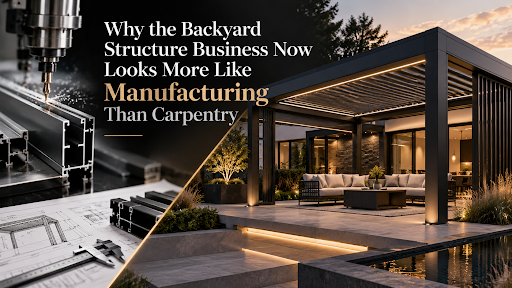
A shade structure used to be a framing job: posts, beams, rafters, a few bags of concrete and a crew that could finish it over a long weekend. The same crew could build a deck on Monday and a fence on Wednesday, because all three used one skill set and failed in the same predictable ways. That version of the work still exists. It is simply no longer what most buyers are shopping for, because the thing they ask about now has a motor in it.
Once a roof moves, the job stops being carpentry. Louvers that rotate on a driven shaft, fabric that retracts along a track, drainage channels cut into the beams and posts, low voltage wiring for lighting and sensors, a controller paired to a phone: that is an assembled machine sitting on a structural frame. Every part of it has tolerances. Every part of it fails in a way a saw cannot fix.
The buying decision moved with the product. Someone comparing pergola contractors in New Jersey today is usually choosing between two different business models rather than two prices, and the difference between them only becomes visible after the structure is standing.
The product changed before the trade did
Three things arrived at roughly the same time and none of them belong to woodworking.
The first is motion. A moving roof means a drive assembly, a power feed, limit settings and a control board, all of it living outdoors in weather it must survive for years.
The second is water management. A fixed cover sheds rain wherever gravity takes it. An adjustable roof is expected to catch water inside the louver profiles, route it through the beams, drop it down hollow posts and release it somewhere deliberate. That is plumbing hidden inside structure, and it has to be designed before anything is cut.
The third is engineered load. Aluminium sections are extruded to a specific profile with a specific span rating. In the Northeast, a roof that must hold accumulated snow while resisting uplift wind is a calculation, not a judgment call made in the yard. Change the span or the post spacing and the calculation changes with it.
Why permits now show up on jobs that used to skip them
Small open structures once slipped past review in plenty of towns. Attach a motor, run electrical service to it, anchor it to a footing or bolt it to a building, and the same structure starts touching several parts of the approval process at once: structural, electrical and often zoning setbacks or lot coverage limits. What triggers review varies by municipality and by state and has to be confirmed locally before anyone signs anything.
The practical effect is that paperwork became a capability. Drawings, load documentation, an electrical scope an inspector will accept and a schedule built around inspection dates are now part of the job itself. Pergola contractors who have never produced stamped drawings tend to discover this halfway through, and the homeowner absorbs the delay.
The split between generalists and specialists
The trade has separated into two groups that both appear to sell the same thing.
| Question | Outdoor living generalist | Specialist fabricator and installer |
| Where the structure comes from | Ordered in as a kit | Engineered and fabricated for the site |
| Who sizes it | Standard sizes from a catalog | Spans set against local load requirements |
| Motor and controls | Frequently subcontracted | Installed and commissioned in house |
| Who answers in year four | Whoever still stocks that kit | The company that built it |
Neither model is automatically wrong. A landscape builder who handles grading, masonry and planting can be the right partner for a simple fixed cover on a level patio. The mismatch appears when a generalist sells a motorized system and then has no route to support it. Specialists such as Vision Art Aluminium sit on the other side of that line, alongside a number of regional fabricators, because the structure gets drawn and built around one address instead of pulled off a shelf.
Service quietly became part of the product
This is the part buyers underestimate. A wooden pergola needs stain. A motorized one eventually needs a replacement motor, a control board, a single louver blade or a fabric panel, in the exact profile that was originally installed. Extrusions and drive components are rarely interchangeable between manufacturers, so availability depends on whether that system is still produced and still handled by the installer.
That is why pergola builders are now judged partly on how long they have carried the same system and whether they service what they sell. It is closer to buying an appliance than to hiring a carpenter, which is why serious pergola contractors raise warranty structure and parts supply before they get to finishes and color.
What a buyer should draw from all of this
Read the category as an engineered product purchase rather than a construction quote. Two proposals carrying the same headline number can differ in wall thickness, engineered snow rating, drainage design, motor quality and whether anyone will answer the phone in the fifth year. The useful question is which of those the price actually includes.
The broader shift is that the qualification for this work has moved. It now sits with companies that can produce drawings, survive an inspection, wire and commission a system and keep parts flowing afterward, whether that is a firm like Vision Art Aluminium or any other outfit that fabricates and services what it installs. That is a manufacturing and service discipline wearing a contractor’s name, and knowing which one you are hiring is most of the decision.