
Privacy is not the same as invisibility. Here is how to reduce unnecessary exposure while keeping control of your assets.
Being more private with crypto is not about hiding wrongdoing. For most people, it is about sharing less information than necessary, limiting the damage from a data breach and retaining control of their money. That matters because the environment around crypto has changed: regulated exchanges collect identity data, public blockchains preserve transaction histories and analytics tools can connect activity that once looked unrelated.
The useful question is therefore not, “Is crypto anonymous?” Most cryptocurrencies are not. A better question is: “Which information am I exposing, who controls my funds and what can I do to reduce avoidable risk?”
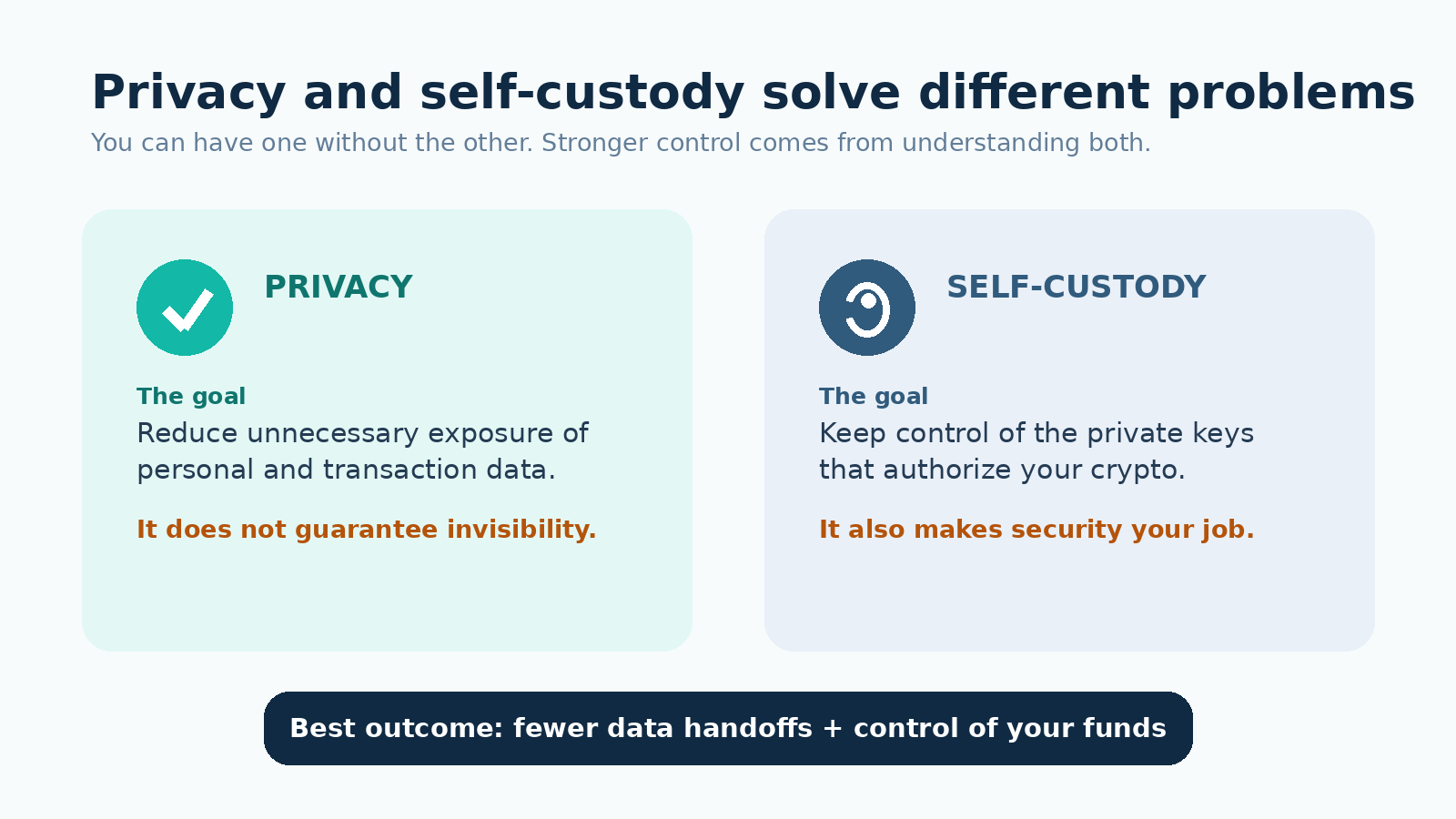
Privacy, anonymity and self-custody are not the same
These terms are often bundled together, but they solve different problems. Keeping them separate prevents a beginner from assuming that a self-custody wallet automatically makes every transaction private.
| Term | What it actually means |
|---|---|
| Privacy | Reducing unnecessary exposure of personal, financial and technical data. |
| Pseudonymity | Using an address or identifier that is not automatically your legal name. Other data can still connect the two. |
| Anonymity | Making activity difficult to link to a person. It is a high bar and should never be assumed. |
| Self-custody | Holding the private keys that authorize transactions, rather than leaving control with an exchange or other custodian. |
What can a public blockchain reveal?
A public blockchain does not normally print your name beside a transaction. It can still expose a durable set of clues, including:
- sending and receiving addresses;
- the amount and time of a transfer;
- balances and earlier transactions connected to an address;
- repeated payment patterns and interactions with known services.
If an address receives funds from an account that has verified your identity, the surrounding activity may become easier to associate with you. Moving the funds again does not automatically erase that history. This is why “no account required” and “anonymous” are not interchangeable claims.
Self-custody changes who controls the funds
With a custodial platform, the provider controls the keys and credits you with a balance. With self-custody, your wallet holds the keys and you authorize transactions. That removes one point of dependency, but it also moves responsibility to you.
A sensible beginner setup includes:
- a reputable wallet downloaded from its official source;
- an offline backup of the recovery phrase, stored away from the device;
- device security, updates and a strong PIN or passphrase;
- a small test transaction when the amount or destination makes that practical.
Critical rule: no legitimate exchange or support agent needs your seed phrase or private keys. Anyone asking for them is trying to take control of your wallet.
Where a non-custodial swap fits
A non-custodial swap service can reduce the need to create another long-lived exchange account. Paysmaker, for example, says standard swaps do not require account creation. The user selects a pair, supplies a destination wallet, sends the source asset to the order address and receives the exchanged asset in the wallet they specified.
Paysmaker also says it does not maintain ongoing customer balances. Funds can be received temporarily to execute an order, then sent to the user’s wallet. That is different from leaving assets deposited on a conventional exchange.
However, the limits matter. Paysmaker states that most standard exchanges do not require KYC, but verification may be requested for anti-money-laundering, legal or internal risk reasons. Its terms also describe transaction monitoring and possible requests for information about the lawful origin of funds. A privacy-focused workflow should be honest about those conditions.
A beginner-friendly swap workflow
Most errors happen because someone rushes an address, network or quote—not because the basic process is complicated.
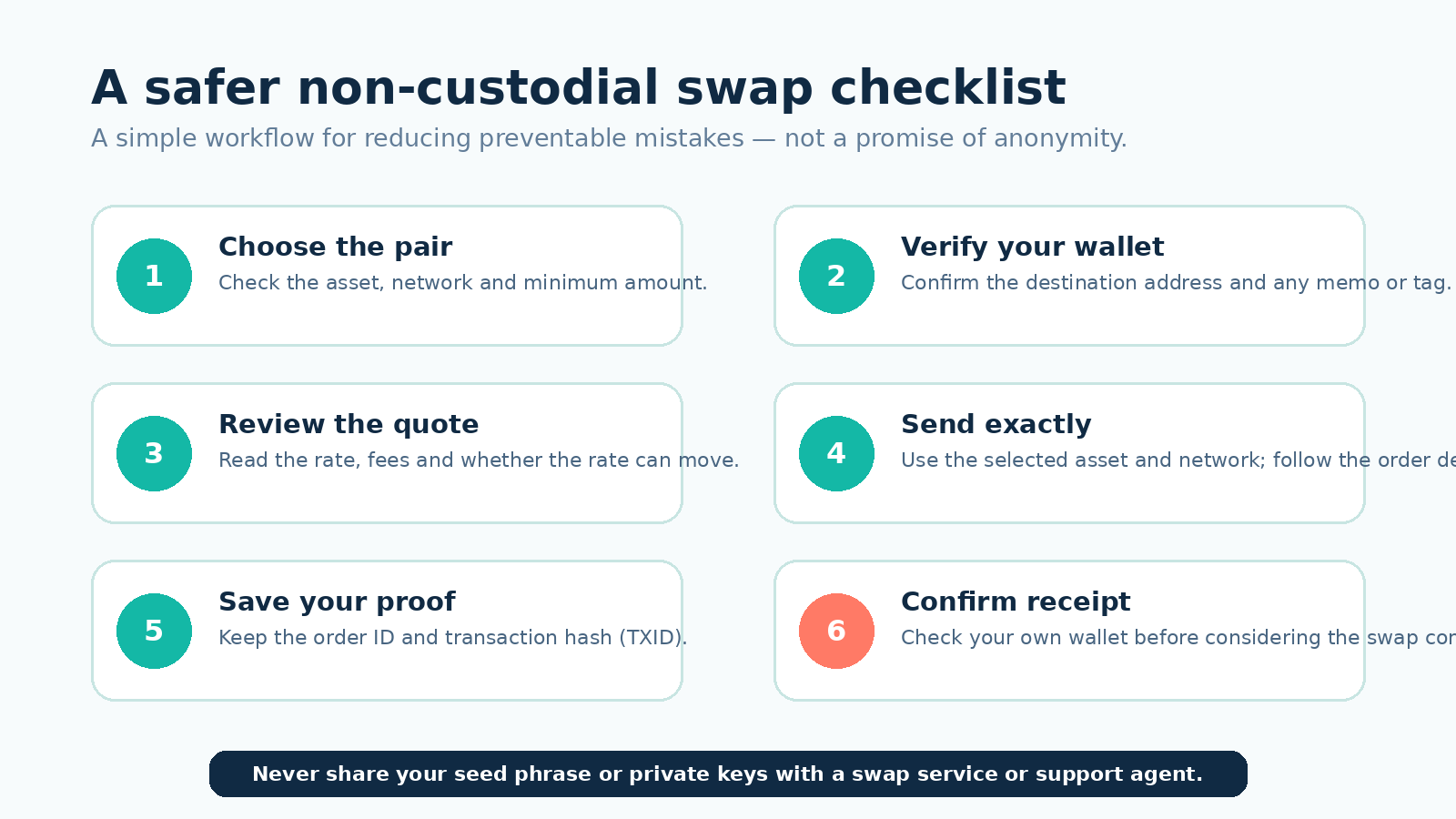
- Choose the exchange pair. Confirm the asset you are sending, the asset you want and the correct blockchain network.
- Enter your destination wallet. Copy and verify the address. Check whether the asset requires a memo, tag or other parameter.
- Review the order. Check the minimum amount, estimated output, network fees and service fees before proceeding.
- Understand the rate. Paysmaker uses floating rates, so the final amount can change with the market, network costs and the time needed for confirmations.
- Send the funds exactly as instructed. Use the chosen asset and network, and avoid splitting one order into multiple payments unless the order explicitly permits it.
- Retain the order details. Save the order ID and transaction hash (TXID). Paysmaker says most swaps complete within 5–60 minutes, although congestion and confirmations can extend this.
- Verify receipt in your wallet. Blockchain transactions are irreversible. Confirm the destination and receipt rather than assuming a support team can reverse an error.
Privacy tools: useful, but not magic
Different tools can reduce different kinds of exposure. None should be treated as a complete anonymity package.
| Tool or choice | What it can help with | What it cannot guarantee |
|---|---|---|
| Privacy-focused assets | Some protocols hide more transaction data by design. Monero, for example, describes privacy as a default property. | Safe counterparties, legal availability or complete protection from operational mistakes. |
| Wallet separation | Cleaner bookkeeping and less casual exposure between different purposes. | That two sets of transactions can never be linked. |
| VPN or Tor | Reducing IP-address exposure to a website or network observer when configured correctly. | Erasing on-chain data or fixing address reuse. |
| Account-free swaps | Avoiding another standing exchange account and keeping the output in your own wallet. | No monitoring, no records, no compliance review or anonymity. |
Five habits that matter more than slogans
- Minimise data by design. Do not provide information a legitimate transaction does not require, but never provide false information.
- Verify every network and address. A familiar token name can exist on several networks; compatibility matters.
- Protect the recovery phrase. Keep it offline, private and recoverable. Never paste it into a website.
- Keep records. Order IDs, TXIDs and cost-basis records help with support, security and tax reporting.
- Know the rules where you live. Privacy is legitimate, but crypto, reporting and tax requirements vary by jurisdiction.
The bottom line
Crypto privacy in 2026 is not a single coin, wallet or setting. It is a series of measured choices: understand what the blockchain reveals, avoid unnecessary data handoffs, keep control of your keys and use services whose real terms match your expectations.
For a beginner, the strongest starting point is not “How do I become invisible?” It is “How do I stay in control without exposing more than I need to?” A non-custodial, account-free swap can be one part of that answer—provided you verify every detail, understand that rates can move and recognise that lawful compliance checks can still apply.