
Introduction
As of 2026, the discussion surrounding byu utah college sports finances has moved beyond simple ticket sales and concessions. The implementation of the House v. NCAA settlement, which began in 2025, has introduced a revolutionary revenue-sharing model that allows schools to distribute approximately $20.5 million annually directly to student-athletes. This new era of “amateurism” is defined by massive media rights payouts, sophisticated Name, Image, and Likeness (NIL) operations, and the ever-present influence of conference realignment.
While both institutions are now competing under the same conference umbrella, their paths to financial stability couldn’t be more different. One relies on a debt-free, donor-heavy model rooted in its unique institutional structure, while the other has embraced innovative private equity partnerships to bridge the funding gap created by shifting conference affiliations. Understanding these two divergent strategies is essential for anyone tracking the economic health of top-tier collegiate athletics in the West.
The Big 12 Media Rights Windfall
The primary engine driving the modern era of athletics in Provo and Salt Lake City is the Big 12 media rights agreement. By the 2025-2026 academic year, the conference reached its “full share” distribution phase for its newest members. This transition moved both schools from partial payouts often half of what legacy members received to full distributions estimated to exceed $40 million per year. This influx of cash has been vital for maintaining competitive facilities and coaching staff salaries.
For the Cougars, this jump in revenue represents the largest financial increase in the history of the program. After years of independence, the stability of a Tier 1 media deal allows for long-term capital planning that was previously impossible. For the Utes, the move to the Big 12 served as a financial lifeline following the collapse of the Pac-12. The security of the Big 12 deal provides a predictable floor for a department that faced significant uncertainty regarding its future media earnings.
Divergent Investment and Debt Philosophies
One of the most striking differences in byu utah college sports finances is how each institution manages its balance sheet. BYU has famously maintained a fiscally conservative, debt-free approach. The university’s athletic department operates with a focus on building cash reserves and avoiding long-term liabilities. This strategy has allowed them to enter the revenue-sharing era with a clean slate, giving them more flexibility to allocate the $20 million required for athlete compensation without cutting existing programs.
In contrast, the University of Utah has recently made headlines by exploring a pioneering partnership with private equity firm Otro Capital. Under the “Utah Brand Initiatives” model, the university is leveraging external investment to modernize its business operations and maximize brand commercialization. While this introduces a level of financial risk and future obligation, it provides an immediate infusion of capital designed to help the Utes compete with the massive budgets found in the Big Ten and SEC.
Revenue Sharing and the House Settlement
The 2025-2026 season marks the full integration of direct athlete payments into the standard operating budget. Both schools are now effectively capping their revenue sharing at approximately $20.5 million, a figure that is expected to rise by 4% annually. Managing this massive new expense line has required a complete overhaul of department budgets. This isn’t just a challenge for football; the funds must be distributed across various men’s and women’s sports to satisfy both competitive and Title IX requirements.
Absorbing a $20 million annual hit to the bottom line has forced both departments to seek new efficiencies. At BYU, the athletic department has hired specialized “Chief of Staff” roles to manage the strategic load of these payments. At Utah, the focus is on “unbundling” the commercial side of the house to ensure that football and basketball revenue can sustain the broader department. Both schools are essentially running professional sports organizations under a collegiate banner.
The Power of NIL and Booster Networks
Name, Image, and Likeness (NIL) has evolved from a Wild West frontier into a sophisticated pillar of byu utah college sports finances. BYU has leveraged its global network of donors and corporate sponsors to create a robust NIL ecosystem. High-profile athletes, such as basketball phenom AJ Dybantsa, have seen NIL valuations reach into the millions, often rivaling professional rookie salaries. This donor-driven model is a key advantage for the Cougars, as their booster base is notoriously deep-pocketed and dedicated.
The University of Utah has countered with a highly organized, community-focused NIL strategy. By centralizing their efforts through collectives and partnerships with local businesses, the Utes have maintained a strong recruiting edge in the Big 12. However, the competition for “fair market value” deals has created a constant arms race. The success of a recruiting class in 2026 is now directly tied to the department’s ability to facilitate these deals, which are separate from but complementary to the school’s direct revenue-sharing payments.
Facility Management and Capital Projects
Maintaining world-class facilities is a non-negotiable expense in 2026. The Utes have continued to invest heavily in Rice-Eccles Stadium and the Huntsman Center, ensuring that gameday experiences remain a significant revenue driver. Ticket sales at Utah represent a major portion of their $100+ million annual revenue, often accounting for nearly 80% of the total ticket revenue among public universities in the state. Upgrades to premium seating and hospitality suites are prioritized to keep high-net-worth donors engaged.
BYU has taken a similar approach with LaVell Edwards Stadium, though their facility upgrades are often funded entirely by private donations rather than municipal bonds or institutional debt. The Marriott Center has also seen technological overhauls to support the global broadcast requirements of the Big 12. For both schools, the stadium is no longer just a place to play a game; it is a multi-purpose commercial asset that must generate revenue through concerts, events, and corporate retreats throughout the calendar year.
Economic Impact on the State of Utah
The financial health of these two programs has a massive ripple effect on the local economy. In 2024, the athletic departments of the state’s public universities contributed over $400 million in economic output. By 2026, with the move to the Big 12 and the increased profile of the “Holy War” rivalry, that number has grown significantly. The University of Utah alone accounts for nearly half of the sports-related jobs in the state, from coaching staff to support roles and administrative personnel.
The “amenity value” of these programs is also a factor in the broader byu utah college sports finances discussion. Nielsen data suggests that Big 12 games involving these schools draw hundreds of millions of viewers, acting as a massive advertisement for the universities and the state as a whole. This visibility drives student enrollment, increases research funding, and attracts outside businesses to the Wasatch Front. The financial success of the athletic departments is intrinsically linked to the prestige of the academic institutions.
Future Projections and Financial Stability
Looking forward to the late 2020s, the sustainability of the current model is the primary concern for both ADs. The $20.5 million revenue-sharing cap is only the beginning; as legal challenges continue, there is a possibility that the percentage of shared revenue could increase. Both schools must continue to innovate their business models to avoid the “debt trap” that has crippled other Power 4 programs. The focus for the next three years will be on maximizing non-media revenue, such as licensing and stadium commercialization.
BYU’s path seems to favor long-term stability through its conservative fiscal policy, while Utah’s more aggressive, investment-heavy approach aims for immediate competitive dominance. If the private equity model succeeds for the Utes, it could become the blueprint for other public universities across the country. Conversely, if BYU’s donor network remains resilient, their debt-free model may prove to be the most “future-proof” strategy in an era of constant economic upheaval in college athletics.
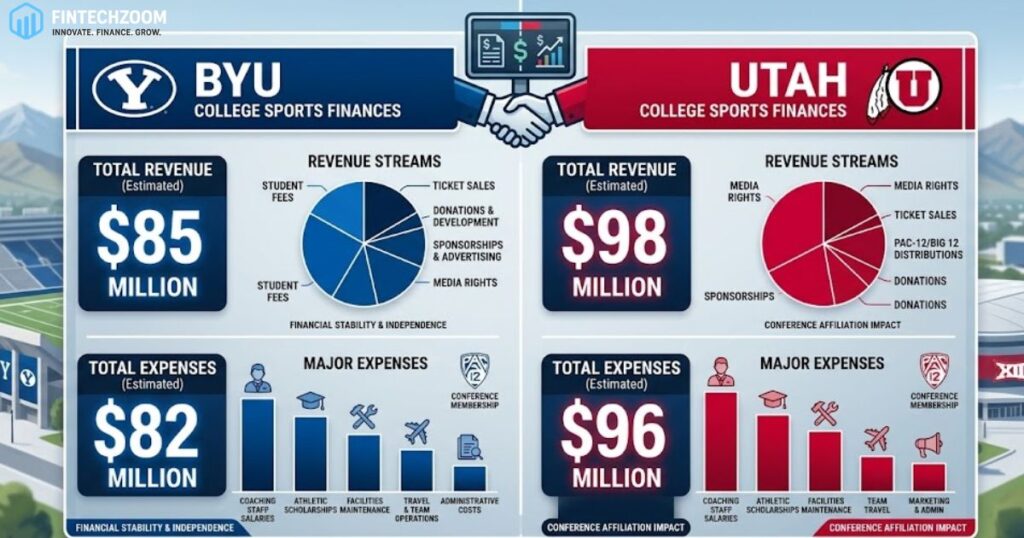
Comparative Financial Overview (2025-2026 Est.)
| Financial Metric | BYU (Estimated) | Univ. of Utah (Estimated) |
| Big 12 Media Revenue | $40M – $45M | $40M – $45M |
| Direct Athlete Rev-Share | ~$20.5M | ~$20.5M |
| Primary Funding Model | Donor/Cash Reserves | Institutional/Private Equity |
| Debt Status | Debt-Free | Moderate/Structured |
| Key Revenue Driver | Global Booster Network | Local Ticket Sales & IP |
FAQs
How do BYU and Utah compare in total athletic revenue?
As of 2026, both schools are operating with budgets exceeding $100 million annually. While Utah has historically reported higher revenue due to its Pac-12 history and large ticket sales, BYU’s transition to the Big 12 has bridged the gap significantly.
Is private equity common in college sports?
No, the University of Utah’s partnership with Otro Capital in 2025-2026 is one of the first of its kind. It represents a shift toward treating athletic departments as commercial brands rather than purely educational auxiliaries.
Does the state government fund these athletic departments?
Very little. For the University of Utah, less than 5% of revenue comes from the main campus, and only about 1.2% comes from state or local government. They are largely self-sustaining business entities.
What happens if a school can’t afford the $20.5 million payment?
Schools that cannot meet the cap may struggle with recruiting and retention, as athletes will likely favor programs that can offer the full 22% revenue share. This could lead to the cutting of non-revenue “Olympic” sports to save costs.
Conclusion
The financial evolution of the BYU and Utah athletic departments serves as a microcosm for the changes happening across the national landscape of collegiate athletics. The year 2026 represents a crossroads where traditional academic values must coexist with the cold reality of professional-grade financial management. While the competition on the field remains as fierce as ever, the real “Holy War” is now being fought on the balance sheets of Provo and Salt Lake City.
Navigating the complexities of byu utah college sports finances requires a delicate balance of risk management, donor relations, and technological innovation. Both institutions have proven capable of adapting to the rapid changes of the Big 12 era, though they have chosen fundamentally different philosophies to achieve their goals. Whether through the Cougars’ debt-free discipline or the Utes’ pioneering investment strategies, the primary objective remains the same: ensuring that the programs can continue to compete at the highest level of the NCAA. As revenue sharing becomes the standard and NIL deals reach new heights, the economic divide between the “haves” and “have-nots” of college sports will only widen. For the fans in Utah, the hope is that these two giants continue to find the resources necessary to keep the state’s storied tradition of excellence alive in this new, expensive world.