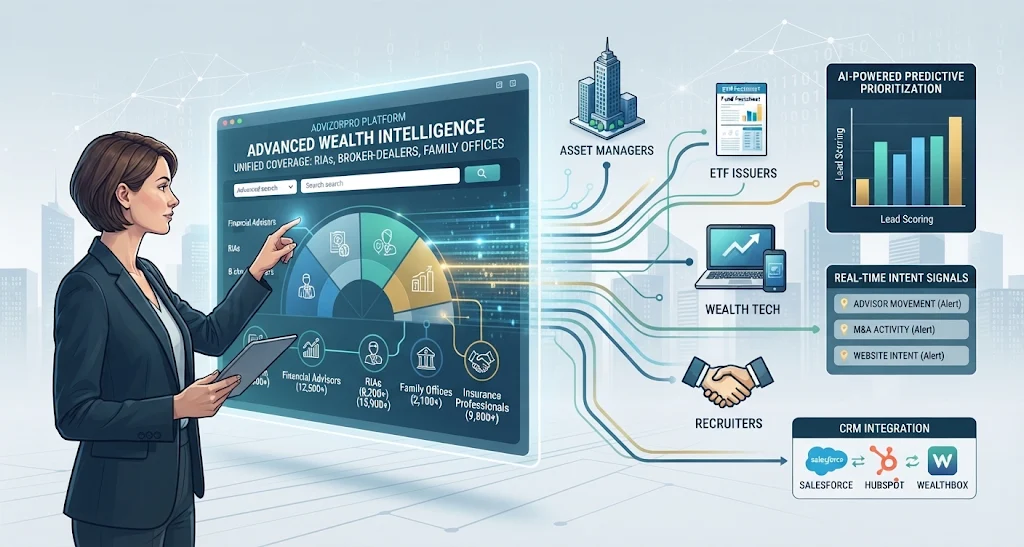
In an increasingly competitive and fragmented wealth management landscape, traditional wholesaling and outbound sales tactics are rapidly losing effectiveness. Generic cold outreach and static, outdated spreadsheets no longer capture the attention of busy financial intermediaries who manage billions in client capital. Instead, forward-thinking financial institutions are turning to specialized B2B sales intelligence platforms—such as AdvizorPro—to gain a decisive competitive edge. By providing verified, comprehensive data across financial advisors, Registered Investment Advisors (RIAs), broker-dealers, family offices, private wealth teams, and insurance professionals, modern data solutions empower asset managers, ETF issuers, wealthtech providers, and executive recruiters to pinpoint ideal prospects, harness AI-driven insights, and execute hyper-targeted outreach through advanced search capabilities, real-time buyer intent signals, and seamless CRM integrations.
1. The Structural Shift in Financial Services Distribution
Over the past decade, assets have steadily migrated away from traditional wirehouse channels toward independent broker-dealers, hybrid models, and fee-only RIAs. Simultaneously, multi-family offices and independent insurance networks have expanded their investment capabilities, creating a far more decentralized distribution map. For institutional sales teams, identifying who controls investment selection and technology procurement within each firm has become increasingly complex. Relying on legacy contact lists leaves wholesalers chasing low-probability leads while missing high-growth boutique firms actively allocating capital.
2. Moving Beyond Raw Regulatory Filings to Actionable Context
Historically, distribution teams relied on periodic SEC Form ADV filings and FINRA BrokerCheck records paired with manual research. While regulatory disclosures establish a baseline of assets under management (AUM) and licensing, they are updated infrequently and lack operational context. Modern sales intelligence platforms bridge this gap by enriching regulatory disclosures through continuous web monitoring, custodial mapping, and entity resolution. When evaluating top RIA firms or fast-growing mid-market practices, revenue teams can immediately see firm hierarchies, custodial relationships, and client demographics in clean, searchable profiles.
3. Unified Coverage Across the Wealth Ecosystem
Using disconnected databases for different advisory channels creates blind spots, especially as hybrid registrations blur traditional boundaries. Comprehensive intelligence platforms consolidate the entire intermediary landscape into one unified ecosystem, offering granular visibility into independent RIAs, aggregator networks, private wealth teams, independent broker-dealers, wirehouse branch offices, single- and multi-family offices, ultra-high-net-worth investment committees, and licensed insurance professionals. This single-source architecture ensures revenue teams never miss cross-channel opportunities or waste time reconciling conflicting records.
4. Precision Prospecting with Advanced Search and AI Insights
When working with millions of advisor records, search precision and prioritization determine sales velocity. Modern platforms pair natural language search with hundreds of specialized filters, allowing reps to isolate firms by custodian, ETF holdings, alternative allocations, or specific portfolio accounting software in seconds. Artificial intelligence further sharpens execution by analyzing historical AUM growth, team expansion, and portfolio turnover to rank leads by conversion propensity. Embedded AI assistants also streamline pre-call preparation by generating instant executive briefings that highlight a firm’s investment philosophy, recent M&A activity, and tailored talking points for personalized outreach.
5. Capturing Real-Time Buyer Intent and Market Triggers
Timing is often the decisive factor in winning a mandate or booking a software demo. Real-time buyer intent signals alert sales teams the moment a prospect enters an active evaluation window. These actionable triggers include advisor movement alerts when wirehouse teams break away to independence or switch broker-dealers, M&A tracking that highlights acquisitions triggering vendor consolidation, and website intent deanonymization that reveals when target accounts download fund fact sheets or engage with digital content.
6. Seamless CRM Integration and Workflow Automation
Market intelligence only generates ROI when embedded directly into daily sales workflows. Bi-directional integration with an investment management CRM—such as Salesforce, HubSpot, Microsoft Dynamics, Wealthbox, or Redtail—turns static data into an automated growth engine. Native integrations automatically route newly identified prospects to territory queues, enrich existing contact records with live firmographic updates, and maintain strict data hygiene through automated deduplication.
7. Strategic Applications and Implementation Best Practices
Different stakeholders across the financial ecosystem apply this unified intelligence in distinct ways to drive growth. Asset managers and ETF issuers analyze firm-level ETF holdings and asset class allocations to accelerate fund flows and expand model portfolio placement, while wealthtech providers query tech stack intelligence to displace legacy vendors and book qualified demos. At the same time, financial recruiters and M&A teams monitor advisor transition propensity scores and headcount expansion to source high-producing teams, and insurance wholesalers filter hybrid advisors by state licensing and product focus to expand high-net-worth producer networks.
To maximize adoption and pipeline impact, revenue leaders must align sales, marketing, and operations around disciplined execution. Organizations achieve the strongest results when they define granular ideal customer profiles based on firmographic and tech stack criteria, enforce strict CRM data governance for automated enrichment, build rapid-response outreach playbooks around real-time intent triggers, and embed AI account summaries into weekly territory planning. By replacing fragmented spreadsheets with verified, AI-enriched market intelligence, financial services organizations empower their distribution teams to focus on high-value opportunities, engage advisors with timely relevance, and build lasting institutional partnerships.