Every generation thinks its payment system is the one that finally got it right. Cheques ruled the counter for decades. Then cards took over. Then digital wallets and mobile banking rewired the whole experience again. The pattern never really stops, and it never really changes either. Each change comes down to the same thing: making money move with less friction.
Right now, you can see that pressure playing out in real time. People want instant payments for groceries, for bills, for splitting a dinner check. They are not chasing novelty for its own sake. They want the transaction to disappear into the background of their day.
Alternative Payment Methods Are Reshaping Consumer Expectations
The move away from traditional bank payments is becoming increasingly visible across global markets. In fact, Casino.com noted that UK fintech firms are increasingly targeting the Polish market as consumers move away from traditional bank payments, using Poland’s growing appetite for digital transactions as an opportunity for expansion.
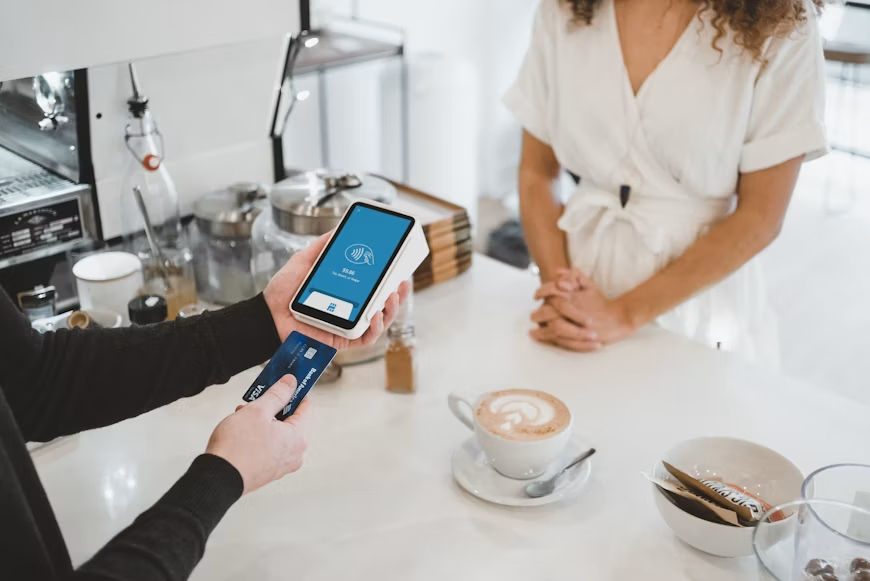
This is part of something bigger than one country, though. Consumers everywhere are getting comfortable with options that feel quicker and more natural than a bank app ever did. Apple Pay and Google Wallet turned checkout into a two-second tap. Peer-to-peer apps made sending money feel about as complicated as texting a friend.
You see this most clearly in emerging markets. A lot of these economies skipped steps entirely. They never built out cheque infrastructure or a deep card culture. They went straight from cash in hand to a smartphone in hand. That leap reset expectations for an entire generation of users, and it is still shaping how new payment products get built today.
Speed Is Becoming One of the Most Valuable Features in Finance
Waiting two or three business days for a transfer to clear feels almost antique now. Instant has become the baseline, not the bonus. Consumers want money sent immediately. They want to check out without ten fields of banking information. Businesses want shorter settlement cycles and fewer points of friction along the way.
Cross-border payments show this shift in sharp relief. The traditional route runs through several intermediaries, each one adding a currency conversion fee and a bit more delay. Fintech platforms and stablecoin rails cut a lot of that out, trimming both the cost and the wait.
India’s UPI system is worth a look here. Through international partnerships like those with Greece and Eurobank, UPI is expanding its reach and making remittances and QR payments more affordable and efficient.
For users, the technical infrastructure matters less than the practical outcome. Funds arrive more quickly and move at a lower cost.
Crypto Infrastructure Is Quietly Becoming Part of Everyday Payments
One of the most interesting developments in payments is how invisible crypto is becoming. Years back, users navigated exchanges and manual conversions to spend assets. Now, companies like Visa, Ripple, and Circle are making it simpler. Stablecoins and fast conversions are reducing friction in the financial system. People want the flexibility to keep digital assets yet spend them easily. Card-linked options and embedded finance are helping reach this goal.
Data reveals a significant jump in stablecoin card transactions. This model is finding success with businesses handling international payments. The blockchain layer often stays hidden from view. That secrecy may ultimately be a key benefit. The best technologies often become so common that people stop seeing them.
Younger Generations Are Accelerating the Change
Demographics play a crucial role in payment evolution. Generation Z and Millennials have never known a world without instant access. They expect payments to be immediate and available wherever they go. Digital wallets and peer-to-peer applications feel like a natural extension of their digital lives. Emerging markets contribute significantly to this shift. Nations such as Kenya, India, and Brazil now lead global mobile money innovation. They prove that digital payments can expand financial inclusion and unlock e-commerce opportunities.
In Kenya, mobile money is deeply embedded in everyday activities. People and businesses transact without depending heavily on traditional banking. The blend of young users and mobile-focused economies fuels growth in alternative payment methods.
Regulation and Institutional Support Are Adding Credibility
Regulatory developments are constructing the structural foundation digital finance requires for growth. Key frameworks, including the European Union’s MiCA rules and evolving United States stablecoin guidance, provide operational clarity. This certainty lowers compliance risk and enables strategic planning for market participants. Institutional adoption follows this regulatory progress.
Banks and payment networks are evaluating blockchain infrastructure for targeted use cases. They want faster settlement finality, programmable payment capabilities, and operational improvements. The main approach emphasizes integration rather than displacement. Institutions are adding blockchain components to existing architectures.
This hybridization marks a structural transformation in financial infrastructure. End-user interfaces remain familiar with cards, mobile apps, and digital wallets. Distributed ledger technology increasingly supports backend processing behind the scenes.
The Real Goal Is Making Payments Feel Effortless
The surge in alternative payment methods points to a fundamental rethinking of financial services. Consumers seldom worry about the rails moving their money. They care about reliability, speed, and affordability above technical details. This focus is driving providers to create solutions that simplify rather than complicate the experience. Challenges remain, especially regarding security measures, system compatibility, and user education.
Various payment systems still need better ways to connect and communicate with one another. Regulators continue working to balance innovation support with appropriate oversight. Yet the broader direction appears increasingly defined. The future of payments may favor hybrid systems that merge traditional finance trust with newer technology speed.