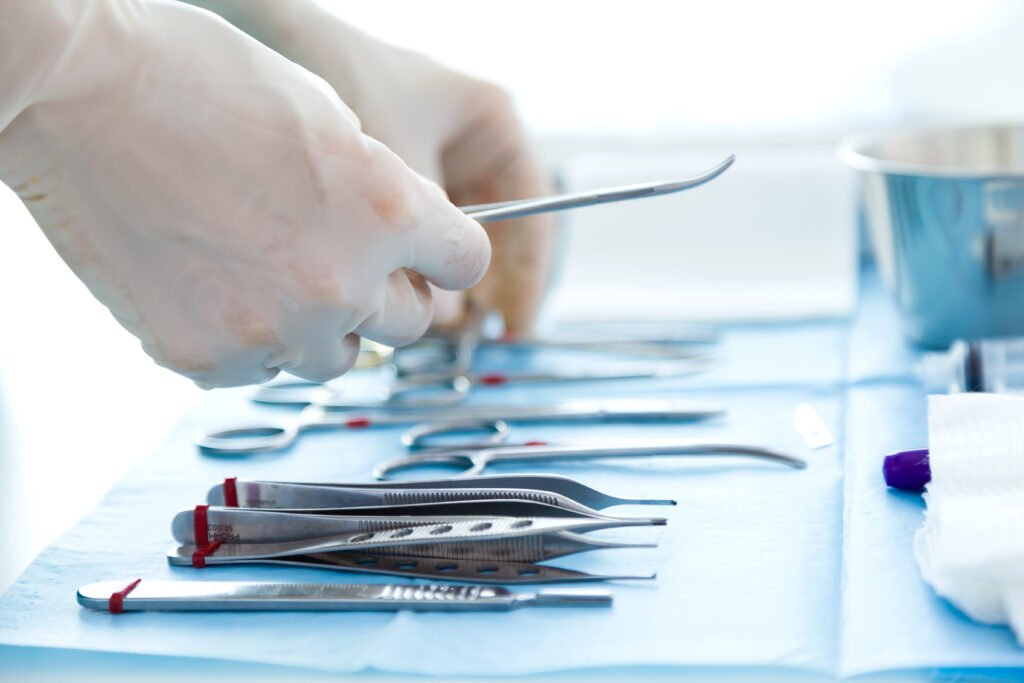
A single operating room tray can hold dozens of instruments, each with a distinct shape and purpose. Surgical instruments are specially designed tools that allow a surgical team to cut, hold, clamp, expose and close tissue with control and precision. Thousands of individual patterns exist, many named after the surgeons who developed them, which is why long lists of surgical instrument names can feel overwhelming at first.
For students and operating room staff, a more practical way to learn the main types of surgical instruments is to start with what each one does. Once you know an instrument’s primary function, its design begins to make sense: a sharp edge exists to cut, a locking ratchet exists to maintain a grip, and a hollow tip exists to draw fluid away. This article explains how surgical instruments are commonly classified, covers each functional group with representative examples, and shows how to recognize an instrument’s category.
How Are Surgical Instruments Classified?
Surgical instruments are commonly grouped by their primary function, meaning the main action they perform on tissue. This function-first approach brings together instruments that look different but do similar work: a scalpel and a pair of scissors look nothing alike, yet both cut.
There is no single universal list of categories, because textbooks and training programs combine or split the groups differently. Some fold clamping into grasping, some treat probes and dilators as their own group, and others add categories such as viewing instruments for specula and scopes. The table below shows the most common groupings.
| Category | Primary action | Representative examples |
| Cutting and dissecting | Incise, divide or separate tissue | Scalpel, Mayo scissors, Metzenbaum scissors |
| Grasping and holding | Hold or manipulate tissue | Adson, DeBakey and Babcock forceps |
| Clamping and occluding | Compress vessels or secure tissue | Mosquito, Kelly and Crile hemostats |
| Retracting and exposing | Hold tissue aside to reveal the operative field | Army-Navy, Weitlaner and Balfour retractors |
| Suturing and closure | Hold the needle and complete wound closure | Mayo-Hegar and Webster needle holders |
| Suction and aspiration | Remove blood, fluid and irrigation | Yankauer, Poole and Frazier suction tips |
| Probing, dilating and access | Explore, widen or create entry to a space | Probes, Hegar dilators, trocars |
Readers who want a deeper reference with names, pictures and general uses can consult this guide to types of surgical instruments.
1. Cutting and Dissecting Instruments
Cutting and dissecting instruments have sharp edges designed to incise tissue, divide structures or separate tissue layers. Cutting means making a clean incision or division, while dissecting means separating tissues along their natural planes.
- Scalpel: A handle fitted with a detachable blade. Blades come in numbered shapes, from larger curved blades suited to longer incisions to small or pointed blades for finer work.
- Mayo scissors: Heavy scissors with sturdy blades, used on tougher tissue such as fascia. The straight version is also commonly used to cut sutures.
- Metzenbaum scissors: Lighter scissors with long handles and comparatively short blades, designed for dissecting delicate tissue.
As these two scissors show, weight, blade length and tip shape usually indicate how delicate the target tissue is.
2. Grasping and Holding Instruments
Grasping and holding instruments allow the surgical team to pick up, stabilize and manipulate tissue without touching it directly. Most belong to the forceps family. Thumb forceps work like tweezers and grip only while pressed, while ring-handled forceps often include a ratchet that holds the grip in place.
The design of the tip or jaw largely determines how an instrument treats tissue:
- Adson forceps: Small thumb forceps available with or without teeth. The toothed version grips firmly and is typically used on skin and other tough tissue.
- DeBakey forceps: Thumb forceps with fine, atraumatic serrations along the jaws, designed for handling delicate tissue and blood vessels.
- Babcock forceps: Ring-handled forceps with rounded, fenestrated jaws that gently encircle delicate structures such as the bowel.
3. Clamping and Occluding Instruments
Clamping and occluding instruments compress tissue or blood vessels and maintain that pressure without a hand on the instrument. The most familiar examples are hemostatic forceps, or hemostats, which are mainly used to help control bleeding by closing off vessels. Other clamps secure tissue, suture ends or surgical drapes.
Most clamps share two features: ring handles and a ratchet that locks the jaws at different levels of closure. Common hemostat patterns differ mainly in size and in how far the serrations run along the jaws:
- Mosquito hemostat: A small, fine clamp for small vessels and delicate work.
- Kelly hemostat: A medium clamp with serrations on the half of the jaws nearest the tip.
- Crile hemostat: Similar in size to the Kelly, with serrations along the full length of the jaws.
A simple distinction separates this group from the last: grasping instruments hold or move tissue, while clamping instruments compress, occlude or secure it.
4. Retracting and Exposing Instruments
Retractors hold tissue, organs or wound edges aside so the surgical team has a clear view of the operative field and room to work. Their size, depth and blade shape generally match the area being exposed, from shallow openings near the skin to deep body cavities.
Retractors fall into two main groups:
- Hand-held retractors: Held in position by a team member. The double-ended Army-Navy retractor is a common example for shallow to moderate depths.
- Self-retaining retractors: Hold themselves open with a ratchet, screw or similar mechanism, which frees the team’s hands. Examples include the Weitlaner retractor, with pronged blades for smaller, superficial openings, and the Balfour retractor, a larger frame used in abdominal surgery.
5. Suturing and Closure Instruments
Suturing and closure instruments help bring tissue together once the main part of a procedure is complete. The central instrument in this group is the needle holder, also called a needle driver, which grips a curved surgical needle securely.
A needle holder resembles a hemostat but has shorter, stronger jaws, often with a crosshatched grip pattern, so the needle does not twist or slip.
- Mayo-Hegar needle holder: A general-purpose pattern suited to a wide range of needle sizes.
- Webster needle holder: A smaller, finer pattern for delicate closures with fine sutures.
Closure also draws on instruments from other groups, such as tissue forceps to hold wound edges and suture scissors to trim suture ends.
6. Suction and Aspiration Instruments
Suction and aspiration instruments remove blood, body fluids and irrigation solution from the operative field. A clear field keeps the tissue visible to the surgical team. Most are hollow tips or tubes connected to a suction line.
- Yankauer suction tip: A rigid tip with a rounded, bulbous end, used to clear larger volumes of fluid.
- Poole suction tip: A straight tube with a perforated outer sleeve that helps keep tissue from blocking the opening, commonly used in abdominal surgery.
- Frazier suction tip: A narrow, angled tip with a small thumb port that lets the user regulate suction, suited to confined areas such as ENT and neurosurgery.
7. Probing, Dilating and Access Instruments
This group covers instruments that explore, widen or open a path into a space in the body. Some educational systems treat probes, dilators and access instruments as three separate categories, while others place them within broader groups such as accessory or specialty instruments.
- Probes: Slender, usually blunt instruments used to explore the depth and direction of a wound, tract or duct.
- Dilators: Instruments that gradually widen an opening or passage. They are typically supplied in sets of increasing diameter, as with Hegar dilators.
- Trocars and cannulas: A trocar creates an entry point into a body cavity, and the cannula keeps it open for other instruments, mainly in minimally invasive surgery.
A Simple Way to Identify an Instrument’s Category
Surgical instrument identification becomes much easier when you look for physical cues instead of trying to recall a name first. Four questions cover most cases:
- What does the working end look like? A sharp edge points to cutting. Teeth or serrations suggest grasping or clamping. A flat blade or rake suggests retracting, a hollow tip suggests suction, and a smooth, blunt shaft suggests probing or dilating.
- How are the jaws or blades designed? Fine serrations usually mean gentle handling, while teeth mean a firmer hold. Short, stout jaws with a crosshatched pattern typically belong to a needle holder.
- Is there a ratchet or locking mechanism? A ratchet means the instrument is built to hold its position unattended, as with hemostats, needle holders and self-retaining retractors. Thumb forceps have no lock because they are meant for momentary grips.
- What is the primary mechanical action? Ask whether the instrument cuts, pinches, locks, spreads, pulls back or draws fluid away. That action usually names the category.
A hemostat and a needle holder, for example, share ring handles and a ratchet, but their jaws quickly tell them apart.
Why Instrument Sets Differ by Specialty
The functional categories stay largely the same across surgical specialties. What changes is the size, length, angle and pattern of the instruments within each category, because each specialty works on different tissue and at different depths.
- General surgery: Commonly draws from a broad basic set that includes instruments from several major functional categories.
- Orthopedic surgery: Adds heavier instruments built for bone, such as bone-holding forceps, rongeurs and osteotomes.
- ENT surgery: Uses finer, often angled or bayonet-shaped instruments to work through narrow openings.
- Gynecology: Commonly uses longer instruments, along with specula and dilators, to reach deeper structures.
A basic tray and a specialty set can look very different, yet both follow the same logic. This is also why suppliers such as Peak Surgicals usually organize their ranges by specialty.
Frequently Asked Questions
What are the main types of surgical instruments?
They are commonly grouped by function: cutting and dissecting, grasping and holding, clamping and occluding, retracting and exposing, suturing and closure, suction and aspiration, and probing, dilating and access instruments.
How many types of surgical instruments are there?
There is no single fixed number. Thousands of patterns exist, and training programs group them differently. Some systems use a few broad groups, while others split instruments into more detailed or specialty-specific categories.
What are the basic surgical instruments?
The most common surgical instruments in a basic set include a scalpel handle, Mayo and Metzenbaum scissors, tissue forceps with and without teeth, several hemostats, a needle holder, hand-held retractors and a suction tip. Exact contents vary by facility and procedure.
Conclusion
Surgical instruments become far easier to learn when you start with function rather than names. Most fit into a handful of groups based on whether they cut, grasp, clamp, retract, close, suction or provide access. Within each group, differences in tip, jaw design, size and locking mechanism explain why so many patterns exist. With this framework, new instrument names and specialty variations become easier to understand, because each traces back to the job it was designed to do.