
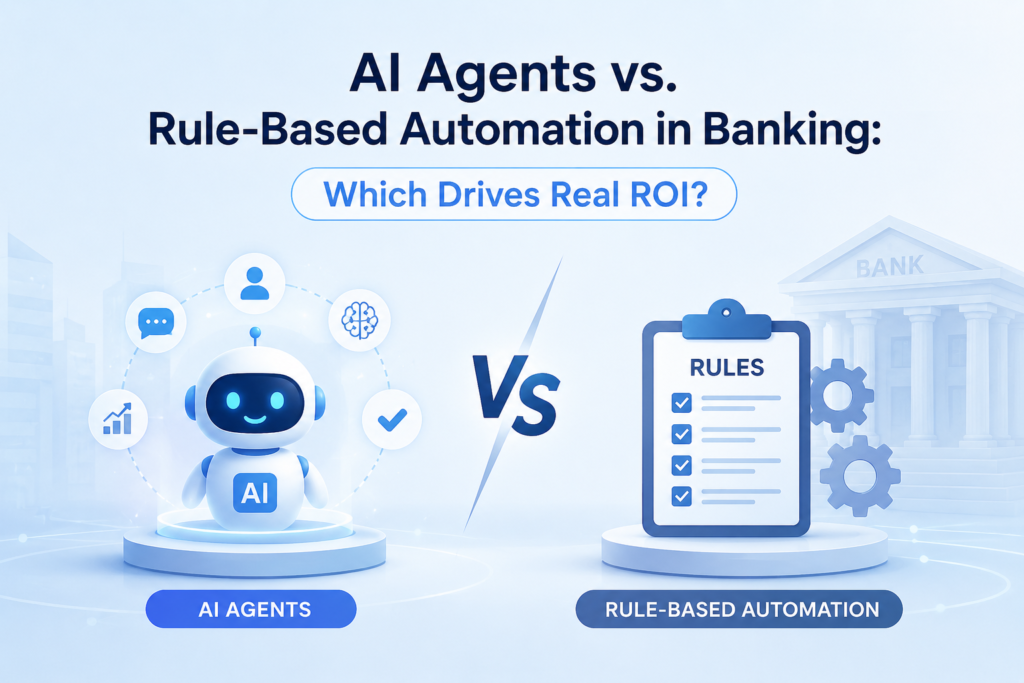
Most banks automating customer-facing operations today are making one of two bets. The first keeps using the rule-based systems that have run contact centres and onboarding queues for the last decade. The second migrates to AI agents that can reason, adapt and resolve in real time.
Both are automation. But they produce fundamentally different outcomes and in the front office, where every failed interaction carries a retention cost, that difference is measurable in revenue, not just efficiency. This article breaks down what actually separates the two, where rule-based logic hits its ceiling and why the ROI math on AI agents looks very different when you factor in what customers experience.
The Core Difference Most Banks Misread
The debate around AI agents vs rule-based automation in banking usually gets framed as a cost question. It shouldn’t be.
Rule-based systems were designed with one goal: To deflect customers from live human agents. When a customer inputs exactly what the system expects, the flow works. When they don’t, and most real interactions don’t, the system fails. It routes the customer to a hold queue and hands the problem to a human agent who has to starts the conversation from zero.
AI agents are built for the opposite objective: Resolve and convert without that handoff. That single distinction shapes every ROI number downstream.
| Dimension | Rule-Based Systems | AI Agents |
| Input handling | Structured, exact-match only | Unstructured, intent-driven |
| Failure mode | Hard error to queue transfer | Exception handling to live resolution |
| Primary objective | Deflect customers from human agents | Resolve and convert |
| Context on handoff | Lost; agent starts from scratch | Preserved across the interaction |
| ROI measurement | Cost deflection | Revenue protection and churn reduction |
Which Is Better: AI Agents or Rule-Based Automation in Banking?
The honest answer depends on what you’re measuring. For a narrow, high-volume, fully predictable task, a balance enquiry with no variation rule-based logic is cheap and reliable. But the moment a customer interaction contains ambiguity, urgency or nuance, the rule-based model breaks down.
Here’s where the gap becomes concrete:
- Resolution ceiling:Rule-based systems historically plateau at around 20% autonomous resolution for front-office interactions. AI agents scale to 60–70% across routine to semi-complex intents.
- Cost-per-call:Deploying AI agents for banking operations, paired with operational redesign, delivers a 30% to 45% reduction in cost-per-call according to McKinsey research.
- Onboarding performance:When a customer uploads an unreadable document, a rule-based bot throws a hard error and rejects the application. An AI agent diagnoses the specific issue, contacts the customer with a targeted correction request and validates the fix in real time. It reduces total onboarding costs by 30% to 40% and cuts time-to-approval by 50%.
- Revenue contribution:Rule-based automation is a pure cost centre. AI agents protect top-line revenue by preventing onboarding abandonment and reducing churn from poor support experiences.
Rule-Based Systems Hide Their Real Cost
One of the most persistent misconceptions in the rule-based automation vs AI automation debate is the compute cost argument. A rule-based chatbot script executes for fractions of a cent. An LLM-powered AI agent costs more per interaction on raw token spend.
On paper, that looks like a point in favour of rule-based systems. In practice, it ignores what happens when those systems fail.
A high-value customer abandoning a mortgage application midway through an IVR loop doesn’t show up as an automation cost. It shows up as lost lifetime value, potentially thousands in revenue attributed to “drop-off.” A corporate client rejected during KYC intake because their document format was unconventional doesn’t appear on the chatbot’s performance dashboard. They just don’t convert.
This is the front-office paradox: the workflow automation in financial institutions that looks cheapest at the interaction level often carries the highest hidden cost at the portfolio level. When you factor in churn, abandonment and brand damage, the rule-based automation vs AI agents cost comparison in banking shifts decisively.
High-Impact Use Cases Where AI Agents Change the Numbers
Understanding where AI agents produce measurable returns means looking at the specific interactions that drive front-office revenue and retention.
Contact Centre and Omnichannel Support
A customer calling to report a card swallowed by an ATM overseas won’t say “Report lost card.” They’ll explain the situation in full, panicked sentences. A rule-based IVR fails this immediately and adds 60 to 90 seconds of manual context-gathering when a live agent finally picks up.
An AI agent handles this in a single conversation, verifying identity passively, detecting the location anomaly, freezing the card and offering a digital replacement, all before the customer finishes explaining. Platforms like GetMyAI enable banks to deliver these real-time, intent-driven interactions across channels without relying on rigid scripted workflows. AI-powered customer support banking at this level isn’t a feature upgrade; it’s a structural shift in what customer care can do.
Customer Onboarding and KYC
Onboarding friction is one of the most expensive problems in retail and corporate banking. Acquisition spend brings customers to the door; a rigid verification bot turns them away. Intelligent agents in fintech are now handling the full exception chain. They read unstructured documents, identify specific gaps and correct them in real time rather than rejecting and moving on. The result is a 50% faster speed-to-approval and meaningfully lower intake cost.
Wealth and Advisory Support
Rule-based CRMs score leads on hard-coded balance thresholds. They can’t prepare a relationship manager for a complex client conversation. AI agents used for banking operations here function as client co-pilots, synthesising market data, surfacing portfolio opportunities and pre-drafting outreach based on each client’s actual history. Advisory teams using this model report 40% to 50% reductions in manual prospecting time and a 30% to 40% lift in net new AUM.
Five Reasons Banks Are Upgrading to AI Agents in 2026
The migration from rule-based workflows to scalable AI automation solutions for large banks is accelerating. These are the operational drivers:
- Production ROI has caught up to the hype.Around 44% of corporate finance teams are actively deploying agentic AI, with mature deployments averaging a 35% realised return.
- Legacy integration walls are being bypassed.Modern AI agents operate via a unified layer above systems of record, letting specialised agents share customer state without breaking existing pipelines.
- Intent-driven execution replaces scripted logic. Agents are assigned an objective and dynamically select the right tools, handling the exceptions that typically freeze standard RPA workflows.
- Regulatory compliance is built in.AI agents auto-compile audit-ready decision logs under the EU AI Act and DORA, eliminating the manual refactoring rule-based scripts required at every policy change.
- Onboarding compression protects acquisition revenue. Enterprise AI automation platforms for reducing banking operational costs cut intake costs by 30% to 40%, recovering revenue lost to onboarding friction.
For banks still evaluating AI agents for financial services efficiency, these are the benchmarks competitors are already working from.
Conclusion: The ROI Question Has a Clear Answer
The fintech automation stack debate isn’t really about technology preference. It’s about what banks are willing to measure.
If the metric is cost-per-script-execution, rule-based wins. If the metric is resolution rate, onboarding conversion, retention and revenue per customer interaction, AI agents win and by a margin that compounds over time.
Enterprise AI automation platforms for banking have moved past the pilot stage. The banks treating agentic AI as an operational default rather than an innovation experiment are the ones building the unit economics that will define the next decade of customer-facing banking. The question for everyone else is how long the current approach can hold before the gap becomes unrecoverable.