Accounts payable has become a priority on the CFO’s desk. Invoice volumes keep rising, vendor networks keep expanding, and Invoicing and tax compliance requirements keep tightening, all while finance teams are expected to run leaner. AP is entering one of the most pivotal moments in its evolution, driven by AI innovation, fraud threats, and regulatory shifts, and it’s pushing AI-powered AP automation from a nice-to-have into a baseline expectation.
Traditional automation, built on OCR and static rule-based workflows, solved digitization but stopped short of real intelligence. Many AP teams are still only partially automated, using OCR for capture while approvals run over email and payments still require manual entry into bank portals. That gap is exactly where AI-powered AP automation earns its place: delivering real value in the areas where AP teams spend most of their time, including coding, handling exceptions, and making decisions, rather than just scanning documents faster. This guide breaks down what genuine AI-powered AP automation looks like in practice, how it differs from rebranded OCR tools, and what CFOs should evaluate before choosing a platform.
Why accounts payable is becoming a CFO priority
The hidden cost of manual invoice processing
Manual invoice processing carries costs that rarely show up as a single line item. Processing one invoice manually can cost a business over ₹1,250, and take roughly three weeks, once you account for opening envelopes, printing emailed invoices, keying data, and chasing approvals. AP clerks typically spend 15 to 30 minutes on each invoice, and at that pace, the labor cost adds up fast for any company processing invoices in volume. What makes this expensive isn’t just the time spent, it’s what that time isn’t being spent on forecasting, vendor negotiation, and financial planning.
Cash flow visibility challenges
When invoice data lives in paper files and disconnected spreadsheets, forecasting turns into guesswork rather than strategic planning. Without real-time insight into payables and receivables, working capital constraints tighten. For a company with around ₹80 crore in annual revenue, even a modest reduction in payment cycle days can free up over ₹1 crore in working capital that would otherwise sit locked in unpaid invoices instead of funding growth. AI-driven AP automation closes this visibility gap by giving finance teams a live, accurate view of what’s owed and when, instead of a picture that’s already outdated by the time it’s compiled.
Supplier relationship risks
Invoice errors don’t just cost time to fix, they damage trust with vendors. A majority of late payments, around 61%, stem directly from invoice errors, which puts pressure on supplier relationships and can affect payment terms, pricing, and priority during supply constraints. Delayed or inconsistent payments also mean missed early payment discounts, which is money left on the table every billing cycle.
Compliance and audit pressure
Regulatory requirements around Invoicing, GST reporting, and audit trails have grown more complex, and manual AP processes weren’t built to produce documentation on demand. Every manually keyed invoice and paper trail is a potential gap in audit readiness, and reconstructing that trail during an audit or regulatory review consumes time finance teams don’t have to spare.
Why finance teams need intelligent automation instead of more headcount
Adding headcount doesn’t fix a broken process, it just adds more people to a workflow that’s fundamentally inefficient. AI-powered AP automation addresses the root problem by removing manual data entry, matching invoices to purchase orders automatically, and routing exceptions without waiting on a person to catch them. This is the shift finance leaders are prioritizing in 2026 rather than scaling AP teams to match invoice volume, they’re implementing AI-driven AP automation to scale output without scaling cost. It’s a more sustainable path for CFOs who need AP to keep pace with the business without inflating the budget.
What is AI-powered AP automation?
AI-powered AP automation is the use of artificial intelligence, including machine learning and natural language processing, to handle the accounts payable cycle from invoice receipt to payment, with minimal manual intervention. Unlike traditional automation, which follows fixed rules to digitize and route documents, AI-powered AP automation learns from historical invoice data, vendor behavior, and past decisions to handle variation and exceptions on its own.
How AI transforms the entire accounts payable process
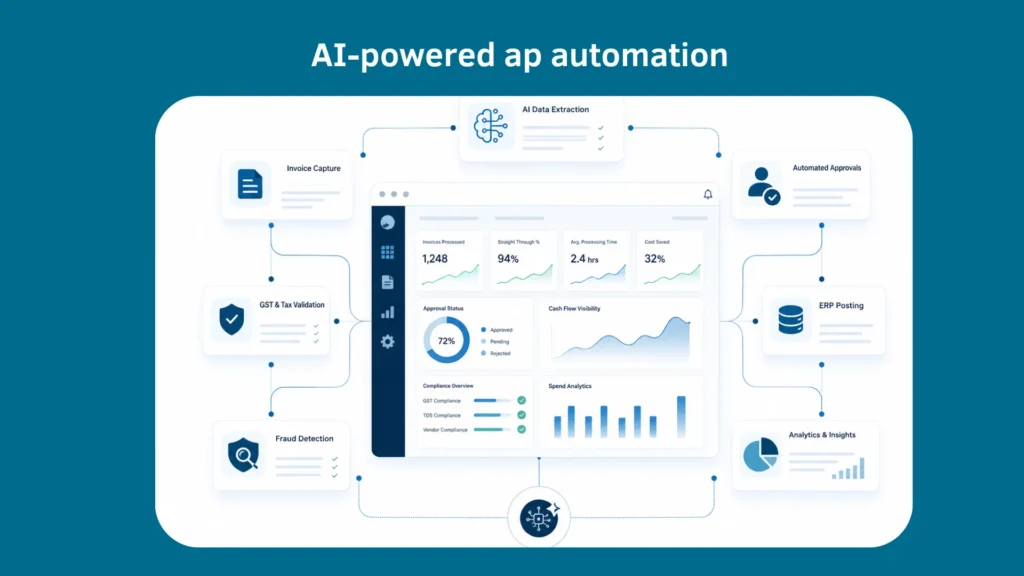
Modern AI-powered AP automation doesn’t just digitize a single step, it restructures the entire invoice lifecycle from the moment an invoice arrives to the moment it’s posted and paid. Here’s how each stage works.
Invoice Capture
Invoices rarely arrive through one channel, and AI-powered AP automation is built to handle that. The system captures invoices from email inboxes, scanned documents direct API integrations, consolidating everything into a single intake point. This centralized capture ensures no invoice slips through the cracks regardless of how a vendor chooses to send it.
Intelligent Data Extraction
Once captured, AI reads the invoice using computer vision and natural language processing rather than fixed templates. It pulls header fields like vendor name, invoice number, and date, extracts line items and totals, identifies GST and tax components, and can work across multi-language invoices without needing manual mapping for every new vendor format. This is what separates AI-driven AP automation from legacy OCR, which typically breaks down the moment a vendor changes their invoice layout.
Invoice Validation
Every invoice is checked against a detailed validation framework before it moves forward. This includes duplicate and fraud detection, GST validation against GSTIN and Rule 46 requirements, vendor master and Udyam verification for MSME status, and tax calculation checks including ITC eligibility and TDS applicability. Validation at this stage is what prevents discrepancies from turning into payment errors downstream.
Three-Way Matching
The system automatically cross-checks the purchase order, goods receipt note, and the vendor invoice to confirm that what was ordered, received, and billed all align. This catches overbilling, pricing mismatches, and unauthorized charges before payment is approved, without an AP team member manually pulling up three separate documents to compare.
Intelligent Approval Routing
Invoices are routed through policy-based workflows based on invoice value, department, cost center, and vendor or PO logic. If an approval is sitting too long, the system triggers automatic escalation based on SLA thresholds, and approvers can act on invoices from mobile devices instead of waiting to be back at a desk. This keeps approvals moving without constant manual follow-up.
ERP Posting
Once validated and approved, invoices post directly into the ERP system, whether that’s SAP, Oracle, Microsoft Dynamics, NetSuite, Tally, or others, with no manual re-entry. This keeps financial records synchronized in real time and removes the risk of transcription errors between systems.
Payment Readiness
By the time an invoice reaches this stage, it has already passed validation, matching, and approval, so it’s fully payment-ready with no last-minute checks required. This also supports timely payments to MSME vendors, which matters under the 45-day payment deadline requirement tied to Section 43B(h) compliance.
Analytics & Dashboards
Finance teams get real-time visibility into payables, vendor spend, approval bottlenecks, and AP aging through centralized dashboards. This turns AP data into a planning tool for cash flow forecasting rather than a static record only reviewed at month-end, giving CFOs the kind of control that AI-powered AP automation is ultimately meant to enable.
Key AI features every CFO should look for
Not every AP tool that claims to use AI actually changes how the work gets done. Here’s what to look for, and why each capability matters from a CFO’s vantage point.
AI invoice capture
The ability to pull invoices automatically from email, vendor portals, PDFs, and API feeds matters because invoice leakage is a real cost. Every invoice that gets missed, buried in an inbox, or manually forwarded late adds friction and delays payment cycles. Centralized, automatic capture removes that dependency on someone remembering to check five different channels.
Smart invoice classification
AI should be able to recognize invoice type, vendor, and category without a human sorting them first. This matters because misclassified invoices lead to wrong approval routing, wrong cost center allocation, and downstream rework that eats into the time savings automation is supposed to deliver.
Automatic GL coding
The system should assign general ledger codes based on historical patterns and vendor history rather than leaving it to manual judgment call by call. For a CFO, this directly affects the accuracy of financial reporting. Miscoded expenses distort cost center visibility and make month-end reconciliation slower than it needs to be.
PO matching
Automated three-way matching between purchase order, goods receipt, and invoice is one of the most important controls in AP. It catches overbilling, pricing discrepancies, and unauthorized purchases before payment goes out, not after. This is a control CFOs should never want to lose to manual review, since manual matching is exactly where errors and fraud slip through.
Duplicate invoice detection
Duplicate payments are a quiet drain on cash that often goes unnoticed until an audit surfaces it. AI-powered duplicate detection catches near-identical invoices, even when vendor formatting or invoice numbering varies slightly, protecting cash that would otherwise require a recovery process to get back.
Fraud detection
Beyond duplicates, AI should be able to flag anomalies like altered bank details, unusual invoice amounts, or invoices from vendors that don’t match the master record. This matters because AP fraud is often engineered to look routine, and a system trained on patterns catches what a busy AP clerk might miss during a normal review cycle.
Vendor verification
Validating vendor details against GSTIN records, Udyam registration, and the vendor master before processing an invoice protects against both compliance risk and fraudulent vendor entries. For CFOs, this is also where MSME classification matters, since it determines which invoices fall under the 45-day payment deadline tied to Section 43B(h).
GST & tax validation
Automated checks against GST rules, tax rates, and ITC eligibility reduce the risk of input tax credit leakage and reconciliation mismatches with GSTR-2B. This is one of the more expensive blind spots in manual AP, since ITC errors directly affect how much tax credit a company can actually claim.
Exception handling
Rather than routing every invoice through manual review, the system should only flag genuine discrepancies, pricing mismatches, missing GRNs, and similar mismatches, for human attention. This matters because it’s what actually frees up an AP team’s time. A system that still routes everything for manual sign-off isn’t really automation.
Predictive analytics
AI that can forecast payment timing, flag vendors likely to raise disputes, or anticipate cash flow needs based on historical patterns gives CFOs a planning advantage. This shifts AP from a reactive function to one that feeds directly into cash flow strategy.
ERP integration
Invoices should post directly into the ERP system, whether that’s SAP, Oracle, Microsoft Dynamics, or others, without manual re-entry. For CFOs, this matters because every manual re-entry point is a place where numbers can diverge between systems, undermining the single source of truth finance depends on.
Audit trail
Every action, capture, validation, approval, and posting, should be automatically logged and traceable. This matters enormously during audits, since reconstructing an approval history from emails and spreadsheets is exactly the kind of work automation is meant to eliminate.
Custom approval workflows
Approval logic should be configurable by invoice value, department, cost center, and vendor, with automatic escalation when approvals stall. This matters because rigid, one-size-fits-all workflows either create bottlenecks for high-value invoices or apply insufficient scrutiny to low-value ones.
AI insights & dashboards
Real-time visibility into payables, vendor spend, and processing bottlenecks turns AP data into something a CFO can actually act on, rather than a static report reviewed once a month. This is ultimately what elevates AP from a processing function to a strategic one.
Benefits of AI-powered accounts payable automation
The value of AI-powered AP automation shows up differently depending on which part of the business is looking at it. Here’s how the benefits break down by outcome.
Financial Benefits
Lower processing cost is usually the first number CFOs look at, and it’s often the easiest to quantify. Manual invoice processing carries labor costs that scale with volume, while AI-driven AP automation reduces the per-invoice cost by removing most of the manual touchpoints. Faster invoice approvals follow closely behind. When routing and escalation happen automatically instead of waiting on someone to check an inbox, approval cycles shrink from weeks to days. That speed directly enables the third financial benefit: early payment discounts. Vendors often offer discounts for prompt payment, but capturing them requires an approval cycle fast enough to act on the terms before they expire, something manual processes rarely achieve consistently.
Operational Benefits
Less manual work is the most immediate change teams notice. AP staff stop spending hours on data entry, chasing approvals, and reconciling mismatches, and that time shifts toward higher-value analysis. Higher accuracy comes as a direct result, since AI-based extraction and validation catch errors before they enter the system rather than requiring correction after the fact. Faster processing ties both of these together fewer manual steps and fewer errors mean invoices move through the pipeline without the delays that manual rework typically introduces.
Strategic Benefits
Better cash flow forecasting becomes possible once AP data is accurate and available in real time, rather than compiled manually at month-end. This gives finance leaders a live view of payables instead of a snapshot that’s already outdated. Better supplier relationships follow naturally from consistent, on-time payments and fewer invoice disputes, since vendors respond to reliability with better terms and priority during supply constraints. Better financial visibility rounds this out: CFOs get a real-time window into vendor spend, aging liabilities, and process bottlenecks, turning AP from a function that gets reviewed to one that actively informs financial strategy.
Compliance Benefits
Audit readiness improves significantly when every capture, validation, approval, and posting action is logged automatically, since there’s no need to reconstruct an approval trail from emails and spreadsheets when auditors ask. Reduced fraud risk comes from automated duplicate detection and anomaly flagging that catches irregularities a manual reviewer might miss, especially in high-volume environments. Regulatory compliance rounds out the category, particularly around GST validation, ITC eligibility, and MSME payment deadlines under Section 43B(h), all of which carry real financial penalties when missed manually. Together, these compliance benefits are often what convinces risk-averse finance teams that AI-powered AP automation isn’t just an efficiency upgrade, it’s a control upgrade.
Best AI-Powered AP automation software in the market
| Software | Best For | Key AI Capabilities | ERP Integrations | Ideal Business Size |
| TYASuite ZeroTouch AP Automation | SMEs and mid-market businesses looking for end-to-end AI-powered AP automation | AI invoice capture, AI data extraction, 71-point AI validation, intelligent exception handling, automated 3-way matching, GST & TDS validation, automated approval workflows, ERP posting, real-time dashboards | SAP, Oracle, Microsoft Dynamics, NetSuite, Tally, Zoho, Infor, Epicor, Workday and more | Small to Enterprise |
| Basware | Large global enterprises | Touchless invoice processing, AI invoice capture, intelligent matching, e-invoicing, analytics | SAP, Oracle, Microsoft Dynamics, NetSuite | Enterprise |
| Coupa | Organizations needing unified spend management | AI invoice processing, spend analytics, supplier management, automated approvals | SAP, Oracle, NetSuite, Microsoft Dynamics | Mid-market to Enterprise |
| Esker | Businesses seeking finance process automation | AI document recognition, invoice extraction, workflow automation, AP & AR automation | SAP, Oracle, Microsoft Dynamics, NetSuite | Mid-market to Enterprise |
| Medius | Companies with complex approval workflows | AI invoice matching, automated coding, fraud detection, workflow automation | SAP, Oracle, Microsoft Dynamics, NetSuite | Mid-market to Enterprise |
Best choice for growing businesses: TYASuite ZeroTouch AP automation is an excellent choice for organizations seeking an AI-first accounts payable solution with intelligent invoice processing, automated validations, seamless ERP integrations, and configurable approval workflows. Businesses with highly complex global requirements may also evaluate other enterprise-focused platforms based on their specific needs.
Measuring ROI of AI-powered AP automation
Implementing AI-powered AP automation is one thing, proving its value to the CFO’s office is another. These are the KPIs that actually demonstrate return on investment, and what each one tells you.
Invoice processing cost
This is the most direct measure of ROI. Track the fully loaded cost per invoice, including labor, errors, and rework, before and after automation. Manual processing typically runs well above ₹1,000 per invoice once staff time and error correction are factored in, while AI-driven automation can bring that down significantly by removing manual data entry and rework from the equation.
Processing time
Measure the time from invoice receipt to final posting. This should shrink from days to hours once AI handles capture, extraction, and validation automatically. A widening gap between your processing time and industry benchmarks is usually a sign that manual bottlenecks remain somewhere in the approval chain.
Straight-through processing rate
This tracks the percentage of invoices that move from capture to payment without any human touch. A high STP rate is the clearest sign that the system is actually working as intended rather than just digitizing paperwork that still requires manual review at every step.
Touchless invoice percentage
Closely related to STP, this measures how many invoices require zero manual intervention across the entire lifecycle, not just at one stage. If your touchless rate stays low even after implementation, it usually points to poor data quality from vendors or validation rules that are too rigid.
Approval cycle time
Track how long invoices sit in the approval queue, from routing to final sign-off. Automated escalation and mobile approvals should compress this significantly. A cycle time that hasn’t improved after automation suggests the workflow logic wasn’t configured to match how your organization actually approves spend.
Exception rate
This measures what percentage of invoices get flagged for manual review due to mismatches, missing data, or validation failures. A high exception rate isn’t necessarily a system failure, it can also reflect genuine data quality issues upstream, like inconsistent PO creation or incomplete GRNs. Tracking this over time shows whether the system is learning and adapting or whether the same issues keep recurring.
Duplicate payments
This is one of the easiest KPIs to quantify in real money terms. Track how many duplicate invoices are caught before payment versus how many would have gone through under the old process. Every duplicate caught is cash that didn’t need to be recovered after the fact.
Early payment discounts captured
Measure how many available early payment discounts were actually captured versus missed. Faster approval cycles are what make this possible, so this KPI is a good indicator of whether speed gains are translating into real financial upside rather than just faster processing for its own sake.
Supplier satisfaction
While harder to quantify, this can be tracked through vendor query volume, dispute frequency, and payment timeliness. Fewer vendor follow-ups about invoice status or payment delays is a strong signal that automation is actually improving the vendor experience, not just internal efficiency.
AP productivity
Measure the number of invoices processed per AP team member before and after automation. Since AI-powered AP automation removes repetitive manual work, the same team should be able to handle significantly higher invoice volume without proportional headcount growth, freeing staff for exception handling and vendor relationship management instead.
Together, these KPIs give a CFO a complete picture of ROI, not just cost savings, but speed, accuracy, compliance, and the strategic capacity AP gains once AI-powered AP automation takes over the repetitive work.
Conclusion
AI-powered AP automation has moved past being a tool for reducing manual effort. For CFOs, its real value now lies in what it enables beyond the AP team itself: tighter financial control, faster decision-making, stronger compliance, and clearer visibility into cash flow and supplier spending. The organizations getting the most out of AI-driven AP automation aren’t just processing invoices faster, they’re using that speed and accuracy to make better calls on working capital, vendor relationships, and where finance resources should actually be spent.
In my view, the shift underway isn’t really about AP catching up to modern technology, it’s about AP catching up to the expectations already placed on the rest of finance. CFOs have spent years demanding real-time data, predictive insight, and tighter controls from every other function. AP was often the exception, still running on email threads and spreadsheets long after other processes modernized. Touchless invoice processing closes that gap, and it does so at a point where invoice volumes and compliance requirements are only going to keep growing, not level off.
The practical takeaway is this organizations that treat AI-driven AP automation as infrastructure rather than a nice-to-have upgrade will be the ones equipped to scale finance operations without scaling headcount at the same rate. That’s not a minor efficiency gain, it’s a structural advantage as the business grows.