Ask anyone who has run a social calendar, a product catalog, or an ad account what actually eats their week, and it’s rarely the creative decisions. It’s the resizing. The reformatting. The tenth version of an asset that already existed, just three pixels off from what a new platform wants. Picsart, the design app used by more than 130 million people, thinks it has found the fix, and it isn’t another editing tool. It’s a small, growing workforce of AI agents that don’t wait to be told what to click next.
The company calls the effort Picsart Agents, and the pitch is blunt: instead of opening an app and doing the work yourself, you hand a brief to an agent the way you’d hand it to a coordinator, and the agent plans the job, does it, and brings back a finished, on-brand result. Picsart’s own tagline for the initiative sums up the ambition without much subtlety: “Your creative team scaled to infinity.”
From four agents to a full studio
Picsart Agents didn’t arrive all at once. The company opened a waitlist in March 2026 and launched with four specialists: Flair, which plugs into Shopify to study market trends and suggest product-photo edits; Resize Pro, which reformats images and video for whatever platform they’re headed to; Remix, which applies a consistent style across an entire photo library in one pass; and Swap, which replaces backgrounds in bulk. It was a modest starting roster for a company that has spent over a decade building single-purpose editing tools, and it read as a genuine change in direction rather than a feature update.
“Creators have been stuck as the operator of every workflow the one doing, not deciding. Our Agents change that relationship: you set direction, the agent builds a plan using real data, you approve, it executes.”
— Hovhannes Avoyan, Picsart founder and CEO
It’s a small sentence with a large claim buried in it that the person’s job changes from operating software to directing it.
Five months on, that four-agent starting lineup has grown into something closer to a full studio roster, with new specialists arriving on close to a weekly cadence. The current lineup includes Zoe, an AI influencer agent that handles daily branded social posting; Maya, who builds presentations from a brief; Mira, a brand-identity builder; Lina, who produces short cinematic video; Marc, a video director who generates and curates footage; and Owen, who turns spreadsheets and data into infographics. Beyond those, Picsart lists specialists for product photography, style transfer, cross-platform resizing, content repurposing, localization, real estate visualization, interior design, and even UX research a spread that suggests the company is less interested in shipping one breakout agent than in covering as much of a creative team’s task list as it can.
How it actually works
The mechanics matter here, because “AI agent” has become one of those phrases that gets stretched to cover almost anything with a chat window attached. Picsart’s version is closer to hiring a very fast, very literal freelancer than to using a smarter version of its editor. You describe the goal in plain language, in a chat, rather than clicking through menus. The agent studies whatever context it has access to brand guidelines, past briefs, product data, performance history and drafts an execution plan before touching anything. Depending on the autonomy level a user sets, that plan either goes straight to execution or waits for a sign-off. Only after approval does the agent actually build, resize, export, or publish the asset.
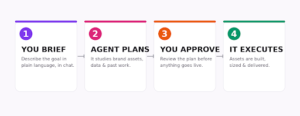
That approval step is doing real work, not just covering the company legally. Handing an algorithm the ability to publish to a store listing or a social feed without a human glancing at it first is the kind of thing that goes wrong in ways that are hard to walk back, and Picsart appears to have designed around that risk rather than around it. Users can dial autonomy up once they trust a given agent, but the default posture is “show me before you ship it.”
The other notable design choice is where the agents live. Rather than requiring a new destination, Picsart Agents work inside WhatsApp, Telegram, and Slack, and can be reached through ChatGPT and Claude as well as Picsart’s own native apps. For a company whose user base skews toward Gen Z creators and social media managers who already run their working lives out of a chat app, that’s a meaningful bit of product sense: the agent shows up where the brief already gets written, instead of asking someone to context-switch into yet another tab.
Agents are also built to accumulate memory rather than start from zero each time. A brand builder agent that’s been fed a style guide once should keep applying it; a resize specialist that’s learned a company’s platform mix shouldn’t need to be told the dimensions again next month. Picsart frames this as agents that “remember brand guidelines, styles, and past briefs” the same institutional knowledge a long-tenured employee would build up, compressed into something that doesn’t forget.
Access follows the freemium shape most people will already recognize from Picsart’s editor. A free tier includes a limited weekly allotment of AI credits, enough to test an agent without committing to anything. Actually putting agents to work at any real volume points users toward Picsart’s premium subscription, which starts at roughly $10 a month on an annual plan modest money next to the cost of a freelancer or a few hours of a designer’s time, if the output holds up.
Who this is actually for

The use cases Picsart is chasing are unglamorous by design, which is probably the point. E-commerce sellers get store-ready product photography without a photographer or a retoucher on staff. Agencies and in-house marketing teams get a way to adapt one campaign into a dozen platform-specific versions without a production assistant pulling an all-nighter before a launch. Real estate and interior design professionals get visualization tools built for a niche most general-purpose AI products ignore. And solo creators and influencers get something closer to a small studio behind them: someone, or something, handling daily posting cadence so the actual person can focus on the parts of the job that still need a human voice.
None of that is about generating something from nothing. It’s about removing the parts of creative work that were never really about creativity in the first place. As Picsart puts it, plainly: “The work you shouldn’t be doing. Handled while you sleep.”
The bigger picture
Picsart isn’t launching this in a vacuum. It reached unicorn status back in 2021 and has spent the years since positioning itself as a faster, more design-forward alternative to Canva, particularly for younger, social-first creators. The AI agent marketplace is a bet that the next competitive line isn’t drawn around better editing tools, it’s drawn around who can remove the most manual labor from a creative workflow while still producing something a brand would actually publish. Every major creative and productivity platform is circling some version of the same idea right now, which makes the marketplace framing notable: Picsart says third-party developers will eventually be able to build and list their own agents, turning what launched as an internal product line into something closer to an app store for automated creative labor.
It’s worth holding two things at once here. The demos are genuinely impressive, and the underlying premise that a huge amount of creative work is repetitive execution rather than judgment – is hard to argue with if you’ve ever resized the same graphic for the ninth platform of the day. At the same time, this is still an early-stage product from a company with an obvious incentive to describe it in the most flattering terms possible, and “the agent plans, you approve” is a safeguard that only works if people actually use it rather than clicking through approvals on autopilot of their own. The interesting question for the next year isn’t whether the agents can produce a passable Instagram carousel. It’s whether creative teams end up trusting them with the judgment calls, or keep them where they’re clearly useful right now: doing the parts of the job nobody wanted anyway.
For now, Picsart Agents are live, with new specialists rolling out weekly and access available through the company’s free and premium tiers, chat integrations, and native apps. Picsart has also said it plans to open the marketplace to outside developers, which would let the agent roster grow faster than any single product team could staff it assuming the quality bar holds as it scales. Whether “your creative team scaled to infinity” turns out to be a marketing copy or an accurate preview of how creative work gets done is the kind of question that answers itself over the next few product cycles, not in a single launch announcement.