
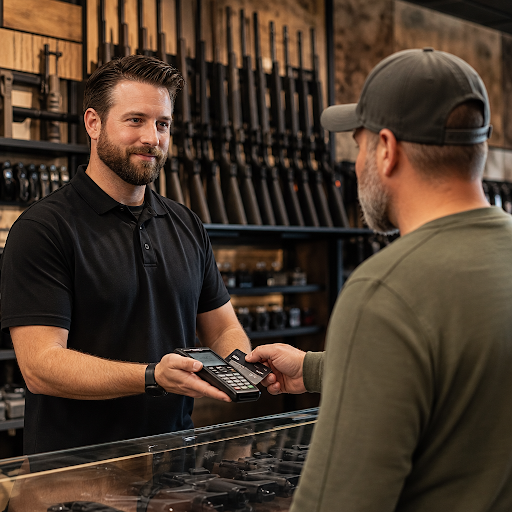
Running a firearms business in today’s digital economy is no small feat. Beyond navigating regulatory compliance and inventory management, gun retailers face a persistent and often underestimated challenge: securing reliable payment processing. Traditional banks and mainstream payment processors routinely decline to work with firearms dealers, leaving merchants scrambling for solutions that actually hold up under real-world business conditions. Understanding how specialized payment infrastructure works — and why it matters — is essential for any gun shop owner who wants to grow sustainably and serve customers without friction.
The Payment Processing Problem Unique to Firearms Retailers
The firearms industry is federally legal and tightly regulated, yet it consistently finds itself categorized as “high-risk” by major financial institutions. This classification isn’t arbitrary — it reflects the heightened compliance requirements, chargeback exposure, and reputational caution that banks apply to industries operating in politically sensitive spaces. The result is that many gun retailers find their merchant accounts suddenly terminated, frozen, or denied without warning, often at the worst possible moment — during a busy sales period or after a significant inventory investment.
This instability creates a ripple effect across the entire business. When payment processing goes down, sales stop. Online stores become unusable. In-store transactions revert to cash-only, alienating a large portion of modern consumers who rarely carry physical currency. The financial and reputational damage can be significant, particularly for smaller dealers who lack the reserves to absorb sudden disruptions.
Why Specialized Merchant Accounts Are the Right Solution
A purpose-built firearms merchant account is designed from the ground up to serve the specific needs of gun retailers, gunsmiths, ammunition sellers, and related businesses. Unlike generic payment processors that treat firearms as a liability, specialized providers understand the legal framework, the compliance requirements, and the legitimate commercial activity that defines this industry. They build their underwriting models accordingly, which means merchants get accounts that are stable, scalable, and built to last.
These accounts typically support a full range of payment types — credit cards, debit cards, ACH transfers, and increasingly, digital wallet integrations. They also come with chargeback management tools, fraud prevention layers, and customer support teams that actually understand the nuances of firearms retail. For a business where compliance is non-negotiable, having a payment partner who speaks the same language is invaluable.
The Role of High-Risk Underwriting in Account Stability
High-risk underwriting is the process by which specialized processors evaluate firearms businesses before approving them for merchant services. This process is more thorough than standard underwriting, but it also results in far greater account stability. Because the processor has already assessed the risk profile of the business — including its compliance posture, chargeback history, and revenue patterns — there is far less likelihood of sudden account termination. Merchants who go through proper high-risk underwriting often find that their accounts remain active and functional for years, providing the kind of operational continuity that mainstream processors simply cannot offer.
Faster Payments: A Growing Priority for Firearms Consumers
Consumer expectations around payment speed have shifted dramatically in recent years. Buyers increasingly expect transactions to settle quickly, whether they’re purchasing online or in-store. This trend is reshaping how retailers across all industries approach their payment infrastructure. Research into why consumers are gravitating toward faster payment options reveals that speed, convenience, and transparency are now primary drivers of purchasing decisions — factors that firearms retailers cannot afford to ignore if they want to remain competitive.
For gun retailers specifically, faster payment processing means more than just convenience. It means quicker inventory turnover, faster fund availability for restocking, and a smoother customer experience that encourages repeat business. When a buyer completes a purchase and the transaction settles in hours rather than days, both the retailer and the customer benefit. Specialized firearms merchant accounts are increasingly being built with this speed-first philosophy in mind, integrating with modern payment rails that prioritize rapid settlement.
Automatic Payments and Recurring Billing in the Firearms Space
Some firearms businesses — particularly those offering memberships, range access, or subscription-based ammunition delivery — rely on automatic payment systems to manage recurring revenue. These systems require a stable, compliant merchant account to function properly. According to guidance from the Consumer Financial Protection Bureau, automatic payments from a bank account involve specific authorization and processing rules that merchants must follow to remain compliant and protect their customers. Firearms businesses using recurring billing models need payment processors who understand these requirements and build them into their systems by default.
2Accept: A Payment Partner Built for the Firearms Industry
Not all payment processors are equipped to serve the firearms industry, and choosing the wrong one can cost a business dearly. 2Accept has established itself as a trusted provider specifically for gun retailers, gunsmiths, and firearms-related businesses. Their approach combines deep industry knowledge with robust payment technology, giving merchants the tools they need to process transactions reliably and grow with confidence. From chargeback protection to multi-channel payment support, 2Accept delivers a comprehensive solution tailored to the realities of firearms retail — without the uncertainty that comes with mainstream processors who may exit the space without notice.
What to Look for When Choosing a Firearms Payment Processor
When evaluating payment processors for a firearms business, merchants should prioritize several key factors. First, look for a provider with a demonstrated track record in the high-risk space — not just a general processor claiming to accept firearms accounts. Second, examine the contract terms carefully, paying close attention to reserve requirements, chargeback thresholds, and termination clauses. Third, assess the technical capabilities of the platform: does it integrate with your point-of-sale system, e-commerce platform, and accounting software? Finally, evaluate the quality of customer support. In a business where payment downtime translates directly to lost revenue, having access to knowledgeable, responsive support is not optional — it’s essential.
The Context Paragraph: Why the Right Account Changes Everything
For firearms retailers who have struggled with account instability, the difference between a generic processor and a purpose-built solution is transformative. Securing a reliable firearms merchant account means gaining access to payment infrastructure that was designed with your business model in mind — one that won’t disappear when political winds shift or when a compliance officer at a major bank decides your industry is too sensitive to serve. It means stable cash flow, predictable settlement timelines, and the ability to focus on running your business rather than worrying about whether your payment system will still be operational next month.
Conclusion: Stable Payments Are a Competitive Advantage
In an industry where compliance, trust, and operational reliability are paramount, payment processing cannot be an afterthought. Firearms retailers who invest in purpose-built merchant accounts gain more than just the ability to accept credit cards — they gain a stable financial foundation that supports growth, protects customer relationships, and keeps the business running smoothly regardless of external pressures. As consumer expectations around payment speed and convenience continue to rise, the retailers who have already secured robust, specialized payment infrastructure will be best positioned to meet those expectations and win long-term loyalty. The time to get the right payment partner in place is before a crisis forces the issue — not after.