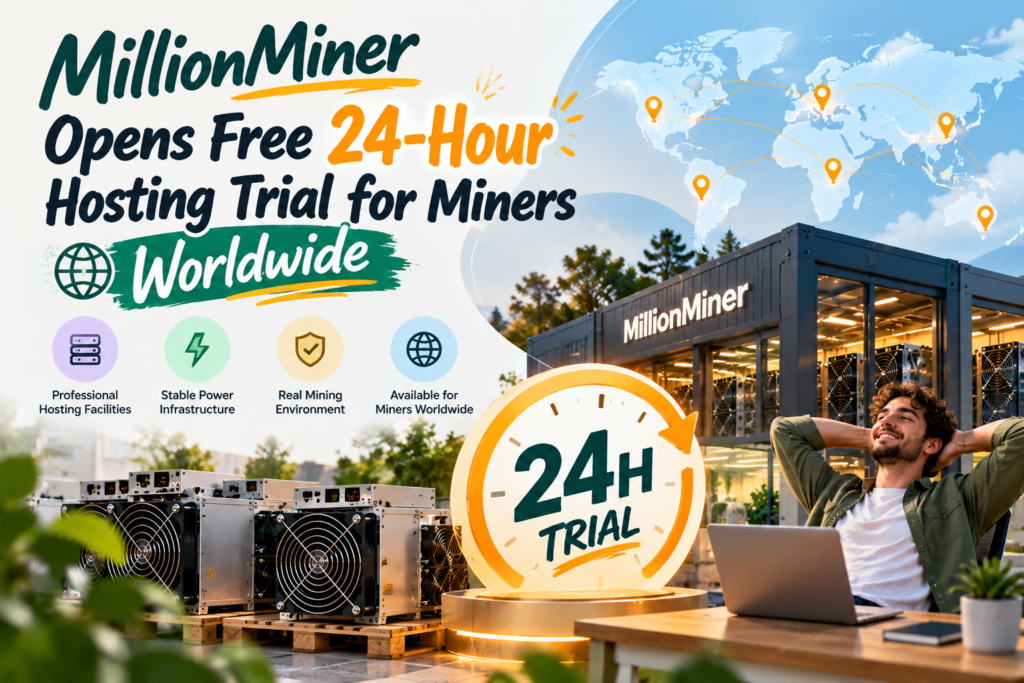
MillionMiner has opened a free 24-hour hosting trial for miners around the world. A miner can place a machine in a professional facility for the first day, watch how it runs, and decide what to do next with no commitment. This guide explains what mining hosting is, why people use it, and what to check before choosing a host.
What is mining hosting?
Mining hosting means a company keeps your mining machine in its own building and runs it for you. You still own the machine and the coins it earns. The host provides the space, the electricity, the cooling, and the internet connection. A simple way to picture it is renting a parking spot for a car, except the machine earns coins while it sits there.
Hosting works for almost any ASIC miner, from a small air-cooled unit to a large liquid-cooled one. The machine only needs to fit the facility’s power and cooling setup.
Why do miners choose hosting instead of mining at home?
Home mining usually runs into three problems: noise, power, and heat. Hosting solves all three in one move.
Is mining hardware really that loud?
Yes. A typical air-cooled machine runs at about 75 decibels, which is close to the sound of a busy street. The fans spin day and night. In a hosting facility, that noise stays inside a building made for it.
How much power does a mining machine need?
Many mining machines need a dedicated 200 to 240 volt circuit, the same kind used for an electric oven. Most homes do not have that wiring in the right room. A new Bitcoin miner can arrive in a few days, but wiring a home for it can take much longer. Home electricity is also often more expensive than industrial electricity, because hosting sites buy power in large amounts.
What about heat and uptime?
A mining machine turns almost all the power it uses into heat. At a hosting site, cooling systems and staff deal with that heat, and the machines are watched around the clock. If one stops working, someone notices quickly. At home, a machine can sit offline for hours before anyone sees it.
What does the free 24-hour hosting trial include?
The trial lets a miner use MillionMiner’s hosting for the first 24 hours at no charge and with no duty to continue. The machine runs on industrial power in a monitored facility. MillionMiner hosts machines in Mississippi, Missouri, and Nebraska in the United States.
The goal is not to promise profit. The goal is to let people see hosting in real life before they decide whether it fits them.
What can you learn in 24 hours?
One day is short, but it answers the basic questions:
- Does the machine start up and connect to your mining pool without trouble?
- Is the hashrate steady, or does it jump around?
- Are the temperatures in a safe range?
- How fast does the host answer when you ask a question?
One day cannot show long-term earnings. Coin prices and network difficulty change every day, so profit needs to be watched over weeks and months. The trial shows whether the setup works. It does not show what you will earn.
Who is the trial for?
It suits three kinds of people. The first has a machine at home that is too loud or too hot. The second just bought hardware and has no place to run it. The third is comparing hosting with home mining and wants proof before moving a machine.
How do you choose a good host?
People who search for the best crypto mining hosting service usually want the same few things: fair power costs, steady uptime, clear rules, and fast help. A simple checklist makes the choice easier.
What should you check before you sign anything?
- Power price: Is the rate fixed, or can it change? Are there extra fees for setup, cooling, or repairs?
- Uptime: How often does the facility go offline, and what happens when it does?
- Contract: How long is the commitment, and how do you leave?
- Repairs: Who fixes a broken fan or hash board, and who pays?
- Location: Do local laws and power rules allow mining there?
- Machine details: Know your machine’s power draw and size first. Hardware guides, such as the ones from MillionMiner, list these numbers for popular models, and a host needs them to plan rack space and power.
Why does the contract matter so much?
Hosting is a long-term arrangement, so a clear contract protects both sides. If anything sounds vague, ask for it in writing before you agree.
Is hosting always better than mining at home?
No. Home mining can work where electricity is cheap, and the machine can sit in a garage or basement away from people. In cold weather, the heat can even help warm a room. Hosting makes more sense when power is expensive, noise is a problem, or the home wiring cannot support the machine. The right choice depends on your own numbers.
Quick answers
Is the trial really free?
Yes. The first 24 hours are free, and there is no obligation to continue.
Do I still own my machine?
Yes. Hosting only provides space, power, cooling, and monitoring. The machine and the coins it earns stay yours.
Can I stop after the trial?
Yes. The trial carries no commitment, so a miner can end it after 24 hours.
Does hosting guarantee profit?
No. Profit depends on coin price, network difficulty, power cost, and the machine itself. Hosting only changes where and how the machine runs.
The bottom line
Hosting moves noise, heat, and wiring problems out of the home. A 24-hour trial lets miners test that idea at no charge and make a calmer decision. Compare power terms, uptime, and contracts, and judge any host by clear answers rather than big promises.