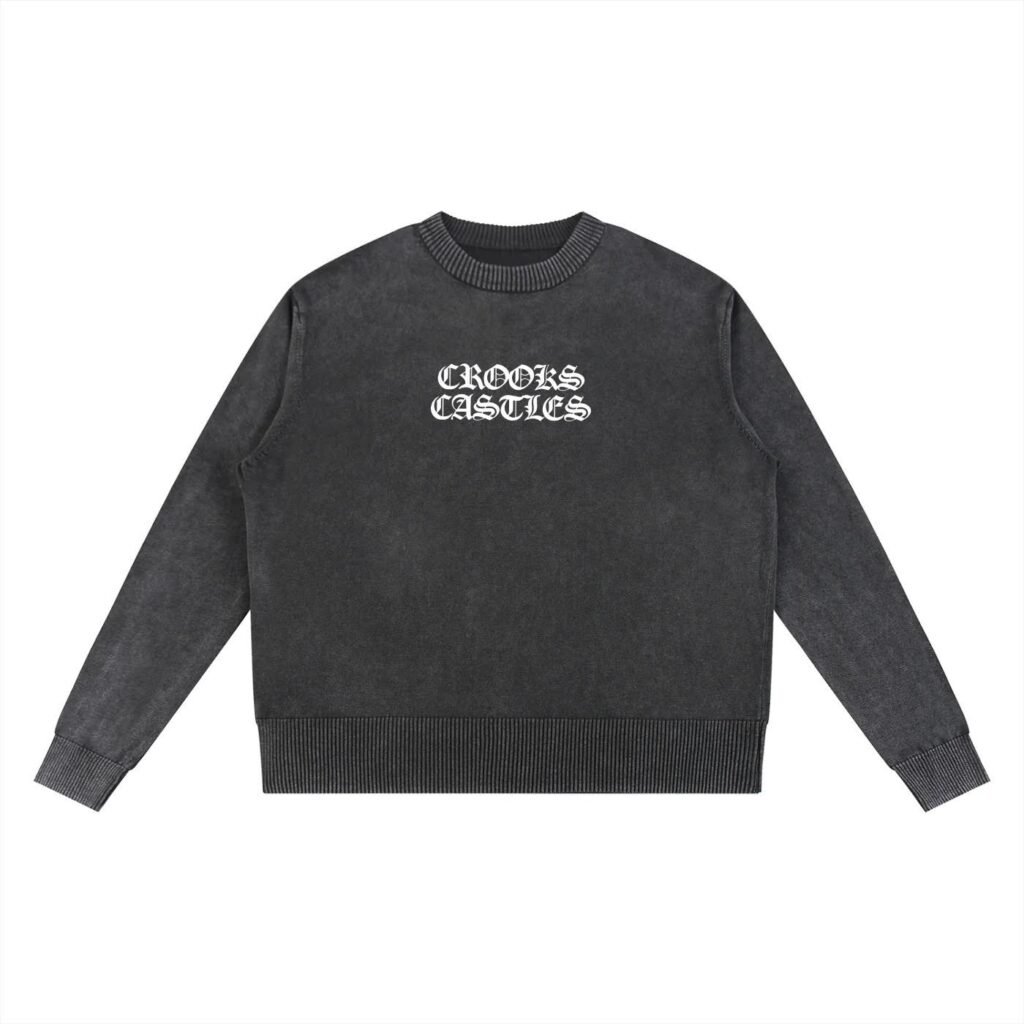
Three tees, one rail, all of them around CA$70, and the tags say mineral wash, snow wash, washed black. Same cotton underneath. Same cut, more or less. And in a year they’ll have gone three different directions, which nobody mentions at the till. Those aren’t colour names, by the way, and that’s where people trip up — they describe something done to the shirt after it was already a shirt. Once that’s straight in your head the tee rail at Crooks and Castles reads a lot less like a wall of grey-black cotton.
So, finishes. Factory words that somehow ended up on a hangtag.
Mineral wash, or controlled mess
Shirt gets sewn. Shirt gets dyed. Then it goes into a drum with a mineral solution and far more agitation than seems sensible, and a good share of that dye comes straight back off — in patches, not evenly, and the patchiness is the whole product. Pale across the chest and over the shoulders, where the cloth caught the worst of the tumbling. Darker down in the seams, where it was tucked away out of reach.
Feels softer than a plain dyed tee of the same weight too, which surprises people — all that knocking about relaxed the fibres before you ever owned the thing. And the colour has nowhere dramatic left to go either, since the fading you’d normally put two summers into happened in forty minutes in a factory somewhere.
What does keep creeping is the contrast. Pale bits go paler, sheltered bits sit tight, and after a winter of wear a mineral-washed charcoal tee honestly looks like two colours sharing one shirt.
Snow wash is the loud one
Same idea, no manners. Instead of a solution you get stones soaked in an oxidizing agent, bouncing around in there, and every time one lands, it burns a tiny pale mark into the surface. A few thousand of those gets you the frosted speckle the name is pinched from. Mineral wash goes cloudy; this one goes spotty, with edges you can actually make out.
Rough on fabric, which is why it turns up on heavier cotton. Stones in a drum with thin jersey, and you’d own a shirt you can read a newspaper through.
Two of them won’t match
Stones land where stones land. Meaning the piece that shows up is its own thing, with its own scatter of marks, and ordering two in the same size gets you cousins rather than twins. Most stop noticing by the second wear. Then later something odd happens — the flecks go soft and sink back toward the base colour, so the shirt drifts toward looking more even as it ages. Mineral wash does the reverse.
Raw edge: a hem nobody closed
Cuff or hem or neckline gets cut, and nothing else is done to it. No fold-under, no coverstitch, no binding tape. On a woven that would be a disaster, because woven threads keep tugging each other loose and the edge walks apart on you. Knit jersey and fleece don’t behave that way. The loops let go for a row, maybe two, roll under themselves, then quit, because each loop is locked into its neighbours.
So you get a few millimetres of fray early on, then nothing for the rest of the shirt’s life, plus a bit more curl with every wash (on a sweatshirt hem that curl is the point, not a fault). Strength’s the trade, mind. A raw cuff gives up long before a stitched one if you stretch your sleeve over your knuckles on the bus.
- A raw cuff sits shorter after a few washes, since the edge rolls in on itself
- A loose thread isn’t the hem failing — on knits the fray runs out of road fast
- Fleece edges go fuzzy rather than frayed, which hides wear better than jersey does
Washed black, because black never holds
Black carries more dye than anything else on that rack. More to lose, basically, and it loses it to sunlight and detergent and plain rubbing. Every black tee you’ve owned went greyish in the end, shoulders first usually. Washed black just gets the fading over with early, at the factory, on purpose.
What lands in the box is a soft off-black. Nearer deep charcoal than ink, with a slightly dusty look outdoors. Under February light in Toronto, when the sky’s already doing grey for you, that sits warmer than a hard black. And since the fade has been and gone, month eight looks much like month one.
Which one handles a wet Vancouver autumn
Rain, mostly. Flat black shows every dark splash off a puddle or a dripping bus shelter until it dries off, and you’ll sit looking at it all afternoon. Whereas a mottled surface has light and dark going on anyway, so the wet patch disappears into the noise. Point to mineral wash there.
Snow wash is fussier for a soaked October, honestly, because those pale flecks are exactly what water darkens. Nothing’s harmed. Goes patchy for an hour, that’s all. Five minutes from the bus? Who cares. Twenty in a proper downpour and I’d save the speckled tee for a drier month.
Same rack, US dollars
The catalogue is mirrored across the border, so anyone reading this from the south finds the same mineral-washed and raw-edge pieces sitting on Crooks & Castles with the figures in US dollars. Same photos, same size run from S to XXXL. Only the currency changes.
Key Takeaways
|
Frequently Asked Questions
Is mineral wash just acid wash under another name?
No. Acid wash is the snow wash process — stones, oxidizer, hard-edged pale flecks. Mineral wash leaves a soft cloudy mottle instead. From a couple of feet away, tell them apart by whether the pale bits have edges.
Will a raw hem keep fraying until the shirt is ruined?
Not on knit cotton or fleece, no. The loops lock each other down after a row or two and the fray stops there. Snip strays flush rather than pulling them, and you’ll forget it’s a raw edge.
Can I order two snow-washed tees and get a pair that match?
You can’t, and nobody could promise it. Stones fall where stones fall.
Do these finishes mess with sizing?
They help, if anything. A garment hammered in a factory wash has done most of its shrinking already, so what you measure on arrival is close to what you’ll have next year. Nothing here is cut small on purpose.
Read the finish word before the colour word — that’s the short version. It tells you what a piece looks like next winter rather than in a product photo, and on a rail where everything’s some flavour of black, that’s the more useful line on the tag. Worth a slow scroll.
READ ALSO: The Handstyle Hoodie Colourways, Ranked by Wearability