
Artificial intelligence is rapidly becoming an essential part of modern enterprise technology. From large language models and generative AI to scientific computing, computer vision, and advanced analytics, today’s workloads require significantly more computational power than traditional CPU-based servers can provide.
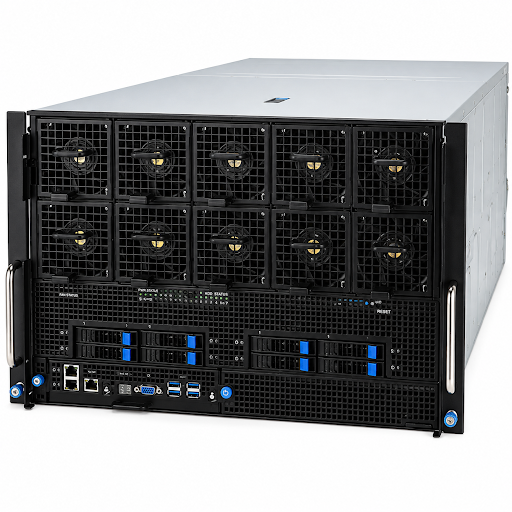
NVIDIA H100 GPU Servers are designed to address these demanding workloads by combining NVIDIA H100 Tensor Core GPUs with enterprise server infrastructure. These systems provide accelerated computing capabilities for deep learning, AI model training, inference, high-performance computing (HPC), and large-scale data analytics.
For organizations building or expanding AI infrastructure, NVIDIA H100 GPU servers offer a proven platform for running demanding workloads while providing the scalability needed for enterprise data center environments.
What Are NVIDIA H100 GPU Servers?
NVIDIA H100 GPU Servers are high-performance computing systems equipped with NVIDIA H100 Tensor Core GPUs.
The H100 is based on NVIDIA’s Hopper architecture and was designed specifically for accelerated computing and artificial intelligence. It combines high-performance Tensor Cores, substantial high-bandwidth memory, and high-speed GPU interconnect technology.
Depending on the server design, an H100 GPU server can contain one or multiple H100 GPUs.
These systems are commonly used for:
- Deep learning
- Generative AI
- Large language models
- AI model training
- AI inference
- Machine learning
- Computer vision
- Natural language processing
- High-performance computing
- Scientific research
- Data analytics
NVIDIA H100 Tensor Core GPU
At the heart of an H100 server is the NVIDIA H100 Tensor Core GPU.
NVIDIA designed the H100 for demanding AI and HPC applications, with specialized Tensor Core technology intended to accelerate matrix and tensor operations.
The H100 is available in different form factors, including SXM and PCIe variants, allowing server manufacturers to build systems for different infrastructure requirements.
A complete H100 GPU server combines these accelerators with CPUs, system memory, storage, networking, power delivery, cooling, and server management capabilities.
NVIDIA Hopper Architecture
The H100 is built on NVIDIA’s Hopper architecture.
Hopper was developed around the requirements of modern AI and accelerated computing workloads. As neural networks and AI models become larger, infrastructure needs to provide not only high compute performance but also rapid movement of data between GPU cores, memory, and other accelerators.
The H100 architecture addresses these requirements through:
- Advanced Tensor Cores
- Transformer Engine technology
- High-bandwidth GPU memory
- NVIDIA NVLink connectivity
- Multi-GPU scaling capabilities
- Support for multiple numerical precision formats
These features make H100-based systems suitable for a wide range of AI applications.
Key Features of NVIDIA H100 GPU Servers
High-Performance Tensor Core Acceleration
Tensor Cores are specialized processing units designed to accelerate the mathematical operations used by deep learning models.
Modern AI workloads perform enormous numbers of matrix calculations. Tensor Cores can accelerate these operations using supported precision formats, helping improve training and inference performance.
This is particularly useful for transformer-based models, which form the foundation of many modern generative AI and large language model applications.
Transformer Engine for AI Workloads
One of the important features of the H100 architecture is NVIDIA’s Transformer Engine.
Transformer models are widely used for:
- Large language models
- Generative AI
- Natural language processing
- Computer vision
- Multimodal AI
The Transformer Engine is designed to accelerate transformer workloads by supporting lower-precision computation while maintaining accuracy through NVIDIA’s software and hardware techniques.
This makes the H100 particularly well suited to modern AI architectures based on transformers.
H100 GPU Memory
GPU memory is one of the most important considerations when selecting an AI server.
The H100 is available with high-bandwidth HBM memory. Depending on the H100 variant, memory configurations include 80 GB and 94 GB versions.
GPU memory is used for:
- Model parameters
- Activations
- Training batches
- Gradients
- Inference workloads
- Intermediate calculations
Large memory capacity allows organizations to work with increasingly sophisticated AI models and larger workloads.
NVIDIA H100 for Deep Learning
Deep learning involves training neural networks using large datasets.
A typical training process involves repeatedly passing data through the model, calculating errors, performing backpropagation, and updating model parameters.
These operations can involve enormous amounts of parallel computation.
NVIDIA H100 GPU servers can accelerate this process through GPU parallelism and specialized Tensor Core hardware.
Applications include:
- Image classification
- Object detection
- Speech recognition
- Natural language processing
- Recommendation systems
- Predictive modeling
- Multimodal AI
NVIDIA H100 for Generative AI
Generative AI has become one of the most important applications for high-performance GPU infrastructure.
Generative models can produce:
- Text
- Images
- Video
- Audio
- Code
- Synthetic data
These applications often rely on large transformer-based models that require substantial compute and memory resources.
NVIDIA H100 GPU servers can provide infrastructure for both the development and deployment of generative AI models.
H100 for Large Language Model Training
Large language models can contain billions of parameters and require enormous computational resources during training.
Training workloads can be distributed across multiple H100 GPUs, allowing organizations to scale beyond the capabilities of a single accelerator.
Multi-GPU H100 servers can provide:
- Higher aggregate compute capacity
- Greater total GPU memory
- High-speed GPU communication
- Support for distributed training
- Faster model development workflows
For very large models, multiple H100 servers can be connected through high-speed networking to form an AI cluster.
H100 for LLM Inference
Training is only one stage of the AI lifecycle.
Once an LLM has been trained, organizations need infrastructure capable of serving the model to applications and users.
H100 GPU servers can support inference workloads such as:
- AI assistants
- Enterprise chatbots
- Natural-language search
- Document processing
- Code generation
- Customer support
- Knowledge management
- AI agents
Inference performance depends on many factors, including model size, quantization, batch size, sequence length, concurrency, and software optimization.
Multi-GPU H100 Server Architecture
Large AI workloads often require multiple GPUs to work together.
H100 server platforms can use NVIDIA’s high-speed GPU interconnect technologies to facilitate communication between accelerators.
NVIDIA NVLink and NVSwitch technologies are particularly important in high-density GPU systems.
Fast GPU-to-GPU communication can help reduce communication overhead during distributed AI training and inference.
This makes multi-GPU H100 servers particularly valuable for large models.
H100 GPU Servers for High-Performance Computing
The H100 is not limited to AI.
GPU acceleration can also benefit high-performance computing applications where calculations can be efficiently parallelized.
Potential HPC workloads include:
- Scientific simulations
- Molecular modeling
- Computational fluid dynamics
- Weather modeling
- Engineering simulations
- Genomics
- Financial modeling
- Research computing
Organizations can therefore use H100 infrastructure across both AI and traditional accelerated computing workloads.
H100 for Computer Vision
Computer vision systems process images and video, often involving large amounts of parallel computation.
H100 GPU servers can support computer vision applications such as:
- Object recognition
- Image classification
- Video analytics
- Medical imaging
- Quality inspection
- Autonomous systems
- Security applications
GPU acceleration can be used during both model training and inference.
H100 for Natural Language Processing
Natural language processing workloads have increasingly shifted toward transformer-based models.
H100 servers can support applications involving:
- Language translation
- Text classification
- Speech recognition
- Question answering
- Text summarization
- Document analysis
- Conversational AI
The combination of Tensor Core acceleration and Transformer Engine capabilities makes H100 infrastructure particularly suitable for modern NLP workloads.
High-Speed Networking for H100 AI Clusters
Large-scale AI training frequently extends across multiple servers.
These servers need high-speed networking to exchange data efficiently.
An enterprise H100 deployment may therefore include:
- Multiple H100 GPU servers
- High-speed Ethernet or InfiniBand networking
- Network switches
- Shared storage
- Cluster management systems
- Monitoring infrastructure
The performance of the overall AI cluster depends on the interaction between compute, memory, storage, and networking.
Storage Requirements for AI Workloads
AI applications often process very large datasets.
High-performance storage is therefore an important component of an H100 infrastructure environment.
Organizations may use NVMe SSDs for local high-speed storage and shared storage systems for larger datasets.
Important storage considerations include:
- Capacity
- Sequential read/write performance
- Random I/O performance
- Dataset size
- Model checkpoint requirements
- Number of concurrent workloads
A slow data pipeline can reduce GPU utilization because accelerators may spend time waiting for data.
CPU and System Memory
Although GPUs perform the primary accelerated calculations, CPUs remain an important part of an H100 server.
The CPU handles:
- Operating system operations
- Data preprocessing
- Application control
- Scheduling
- Network operations
- Storage management
System RAM also provides workspace for datasets and applications.
A balanced CPU, RAM, GPU, and storage configuration can help maximize overall system efficiency.
Power and Cooling Considerations
High-performance GPU servers can have substantial power and thermal requirements.
Organizations deploying H100 servers should evaluate:
- GPU power consumption
- Server power requirements
- Power distribution
- Rack capacity
- Cooling capacity
- Airflow
- Thermal density
- Liquid-cooling requirements where applicable
These factors become particularly important when deploying multiple H100 GPUs within a single rack.
Enterprise Applications for NVIDIA H100 GPU Servers
Healthcare and Life Sciences
H100 infrastructure can support AI applications involving medical imaging, drug discovery, genomics, and scientific research.
Financial Services
Financial organizations can use accelerated computing for quantitative analysis, risk modeling, fraud detection, and machine learning.
Manufacturing
GPU-powered AI can support visual inspection, predictive maintenance, robotics, and digital simulation.
Retail
Retail organizations can apply AI to recommendation systems, customer analytics, demand forecasting, and conversational applications.
Research and Academia
Researchers can use H100 GPU servers for deep learning, scientific simulations, and other computationally intensive projects.
Enterprise Generative AI
Businesses can use H100 infrastructure to build internal AI assistants, document intelligence systems, enterprise search platforms, and other generative AI applications.
Benefits of NVIDIA H100 GPU Servers
Accelerated AI Training
H100 Tensor Core technology is designed to accelerate demanding deep learning and transformer workloads.
High-Performance AI Inference
H100 servers can provide substantial computational resources for enterprise AI inference.
Multi-GPU Scalability
Multiple H100 GPUs can work together in high-performance server architectures.
Broad Workload Support
The same infrastructure can support AI, deep learning, HPC, analytics, and scientific computing.
Enterprise Data Center Integration
H100 servers can be deployed with enterprise networking, storage, management, and monitoring infrastructure.
How to Choose an NVIDIA H100 GPU Server
Organizations should evaluate their workloads before selecting an H100 server configuration.
Important factors include:
- H100 GPU count: How many GPUs are required?
- GPU memory: Will the model fit within the available GPU memory?
- GPU form factor: Is an SXM or PCIe configuration more appropriate?
- CPU: Can the CPU support the intended workload?
- System RAM: How large are the datasets?
- Storage: What data throughput is required?
- Networking: Will the server participate in a multi-node cluster?
- Power: Can the facility support the server?
- Cooling: Is sufficient thermal capacity available?
- Software: Are the required AI frameworks and drivers supported?
- Scalability: Can additional GPU servers be added later?
NVIDIA H100 GPU Server vs. CPU-Only Server
| Feature | NVIDIA H100 GPU Server | CPU-Only Server |
| AI Training | Highly suitable | Less efficient for large workloads |
| Deep Learning | Excellent | Limited compared with GPU acceleration |
| LLM Workloads | Highly suitable | Generally unsuitable for large-scale workloads |
| AI Inference | Excellent for demanding workloads | Suitable for selected applications |
| Parallel Processing | Extremely strong | General-purpose |
| HPC Acceleration | Excellent for GPU-compatible workloads | Suitable for CPU-based workloads |
| Power Requirements | Typically higher | Typically lower |
| Initial Infrastructure Cost | Higher | Lower |
The right architecture depends on the workload. CPU-only servers remain appropriate for many enterprise applications, while H100 systems are designed for workloads that benefit from high levels of GPU acceleration.
Building a Scalable H100 AI Infrastructure
A single H100 server may be sufficient for development, testing, or smaller inference workloads.
Large enterprise AI initiatives may require multiple servers operating together.
A scalable infrastructure can include:
- H100 GPU servers
- High-speed networking
- Shared storage
- Cluster management
- GPU scheduling
- Container orchestration
- Monitoring and observability
- Backup systems
- Security infrastructure
This approach allows organizations to expand computing capacity as AI workloads increase.
Why NVIDIA H100 GPU Servers Remain Important for AI
The NVIDIA H100 established itself as a major data center accelerator for AI and HPC workloads.
Its combination of Hopper architecture, Tensor Core acceleration, Transformer Engine technology, HBM memory, and high-speed GPU interconnect capabilities makes it suitable for many demanding workloads.
Although newer GPU generations are available, H100-based infrastructure remains relevant for organizations that need proven accelerated computing platforms and established AI software compatibility.
Conclusion
NVIDIA H100 GPU Servers provide a high-performance foundation for organizations developing and deploying deep learning, generative AI, large language models, machine learning, and high-performance computing applications.
The H100’s Hopper architecture, Tensor Core acceleration, Transformer Engine, high-bandwidth memory, and multi-GPU connectivity make it well suited to demanding AI workloads.
For enterprises, choosing an H100 server should involve more than evaluating GPU specifications. CPU performance, system memory, storage, networking, power, cooling, software compatibility, and future scalability all contribute to the performance of the complete AI infrastructure.
Whether an organization is training large language models, deploying generative AI, developing computer vision systems, or performing scientific research, an appropriately configured H100 GPU server can provide the accelerated computing capabilities required for demanding workloads.
For businesses sourcing enterprise GPU servers, AI infrastructure, networking, storage, and data center technology, Saitech offers a broad range of enterprise computing solutions.
Frequently Asked Questions
What is an NVIDIA H100 GPU Server?
An NVIDIA H100 GPU Server is an enterprise computing system equipped with one or more NVIDIA H100 Tensor Core GPUs for accelerating AI, deep learning, inference, HPC, and other compute-intensive workloads.
What is the NVIDIA H100 used for?
The H100 is used for AI model training, generative AI, large language models, inference, deep learning, computer vision, scientific computing, and high-performance data analytics.
How much memory does an H100 have?
NVIDIA H100 GPUs are available in different configurations. Depending on the specific model and form factor, H100 products include 80 GB and 94 GB memory configurations.
Is the H100 suitable for LLM training?
Yes. H100 GPUs are designed for demanding AI workloads and can be combined in multi-GPU systems for large-scale language model training.
Can an H100 server be used for inference?
Yes. H100 GPU servers can support enterprise inference workloads, including LLMs, generative AI, computer vision, NLP, and other AI applications.
What is the difference between H100 SXM and PCIe?
H100 SXM and PCIe are different GPU form factors designed for different server architectures. SXM configurations are commonly used in high-density, tightly interconnected GPU systems, while PCIe versions are designed for servers using PCIe expansion.
How many H100 GPUs can a server have?
The number depends on the server platform. Enterprise GPU servers are available in configurations ranging from one or several GPUs to high-density multi-GPU systems.
What should I consider before buying an H100 GPU server?
Consider GPU count, memory requirements, CPU and RAM, storage, networking, power, cooling, server form factor, software compatibility, workload requirements, and future expansion plans.