
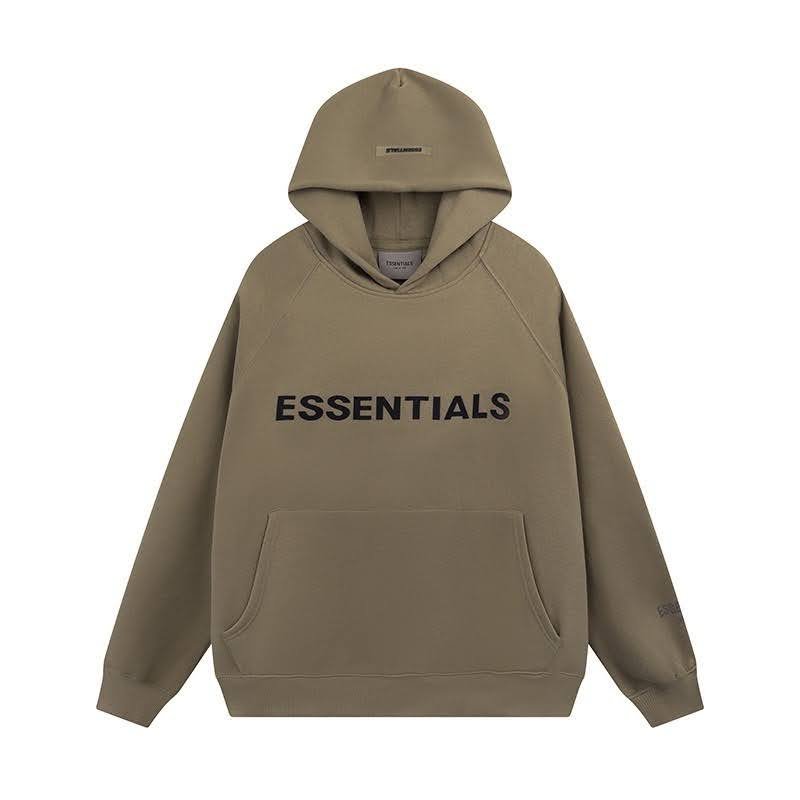
Milan in January runs between 0 and 8 °C, and that number lies to you. The damp does the damage. Fog sits on the plain, the air turns wet, and wet air walks through a coat and settles in your shoulders while you wait for a tram at half past seven. You’ll see people in serious mountain jackets shivering at 3 °C, because they wore one thick thing instead of three thin ones. That gap, between what a coat promises and what winter here delivers, is where the fleece at Essentials Italy earns its place.
One garment won’t carry you from November to February. Three will, and each of them can be thinner than you’d guess.
A fleece hoodie is a middle layer, not a coat
Insulation is trapped air, nothing more clever. Cotton fleece holds air well because the brushed side is a tangle of short fibers with pockets between them, and air moves heat badly. What a hoodie lacks is a windproof face and a water barrier, so on its own at 2 °C with any breeze it quits in ten minutes. Put something wind-stopping over it and the same hoodie becomes the warmest thing you own.
So stop asking how warm a hoodie is. Ask what it is warm underneath. The popover and full-zip Classic Fleece cuts in the felpa range — felpa being the Italian word for a hoodie — are heavy enough. Cropped fleece isn’t, because a short hem leaves your lower back bare every time you sit down.
Building the stack from the skin out
Three layers, three separate jobs. The base moves sweat off your skin. The middle holds heat. The shell stops wind and water. Get one wrong and the other two stop working, which is why people with expensive coats still end up cold.
- Base: a long-sleeve cotton tee or thin merino, close to the body, nothing loose
- Middle: the hoodie, heavyweight cotton fleece, room to move but not room to flap
- Shell: anything that blocks wind — a wool overcoat, or a technical jacket when it rains sideways
- Neck and hands, which is where most of the complaining starts
Two tees under a hoodie is not a stack. It is just two tees. Layers need different jobs, not more of the same one. A heavyweight crewneck from the maglietta range does work better as a base than a thin tee, because it holds some heat without adding bulk at the shoulder.
Temperatures, and what actually goes on
Numbers help more than adjectives. This is what works in Milan and Turin from November to February. Shift it one level colder for Trentino and the Alps, where there is snow rather than fog.
| Temperature | What goes on | Notes |
| 8 to 12 °C | Hoodie alone, hood down | Late November afternoons, and most of March |
| 4 to 8 °C | Tee, hoodie, unlined overcoat | The standard Milan winter day |
| 0 to 4 °C | Thermal base, hoodie, insulated shell, scarf | Damp and still, the worst kind |
| Below 0 °C | Add a second thin mid layer, cover the neck | Trentino, the Alps, early mornings |
| Rain, any temperature | Waterproof shell over everything | Cotton fleece soaks and stays wet |
Autumn and spring up north are harder than winter, honestly. One day swings from 10 to 20 °C and back. A hoodie you can tie round your waist beats a coat you then carry for six hours.
Oversized cuts help the stack, until they don’t
Air is the point here, and the cut gives you some for free. The range runs S to XL, drafted big throughout, so a 48 off an Italian label converts down to an M — roomy, yes, but an M. That volume matters when layering: a mid layer insulates with the air trapped inside it, and one pulled tight is just a thin layer. The Felpa Essentials uomo selection runs to around 50 pieces between €70 and €85, marked down from €230–246, so you can choose by weight and hem length instead of taking whatever survived in your size.
The shoulder is where it goes wrong. Oversized fleece under an oversized coat means sleeve fighting sleeve, and your arms end up bound at the elbow. If your coat is already generous, take the hoodie at your true size. I’d take a snug mid layer over a coat I can’t reach into my pocket in.
Hood or crewneck under a winter coat
A hood under a collared overcoat bunches. No clever fix — the fabric has to go somewhere, and it goes up the back of your neck. Then again, a bunched hood is a warm hood, and on a wet platform you’ll want it over your head and tucked under the collar. A full zip helps too: you can vent it on a crowded tram without taking anything off.
Crewnecks lie flatter under a coat, so they win on days you have somewhere to be. Popovers win on the days you don’t.
Fog, drizzle and wet fleece
Cotton is the weakness of cotton fleece. It absorbs water, holds it, and pulls heat out of you the whole time it dries, which indoors takes hours. Milan doesn’t get dramatic winter rain. It gets fog and fine drizzle for days, and that slow soaking is what ruins a hoodie you were sure was dry.
Which is why a shell isn’t optional in December. The nylon pieces in the same category shed drizzle far better and work over a hoodie down to about 5 °C. Below that, put real insulation on top and keep the fleece dry underneath. A dry hoodie at 0 °C beats a damp one at 6 °C.
Frequently Asked Questions
Can a hoodie be my only warm layer in Milan in December?
On a dry, still afternoon at 8 °C, yes. At 2 °C or in fog, no. Fleece has no wind barrier, so a breeze halves the insulation and the damp finishes the job.
Should I size up if I plan to layer?
Only up to a point. You want air inside the hoodie, not fabric wrestling your coat. The cut already runs oversized, so most people layering under an overcoat are better off at their normal size.
How early do I need to order for a cold snap?
Allow three weeks and you are fine. Dispatch needs a business day or three, then standard delivery runs 8 to 12 working days for €15, or 6 to 10 at €30. Mid November for January is comfortable. The week the fog arrives is not. Size and color amendments only stand for a day after you pay.
Pick one heavyweight fleece, keep it dry, and put something windproof over the top. That covers nearly every day from November to February without a bulky coat. Sort it out while the weather is still mild.
READ ALSO: Artem Sailcloth Watch Straps Review: My Experience With the Strap That Made Artem Famous